As in the last 2 years, I finish my trip to West Virginia by traveling down to Delaware, to spend a few days at Bombay Hook National Wildlife Refuge. This year, Bombay Pork is celebrating its 75th anniversary.

A few facts about the refuge from the government's brochure: " Bombay Hook National Wildlife Refuge was est. March 16, 1937 as a resting and feeding area for migratory and wintering waterfowl. The refuge was purchased from local landowners would Federal duck stamp funds. Today the refuge totals 15,978 acres".
"On April 1, 1938, the Civilian Conservation Corps (CCC) based at Leipsic started work on the refuge. The CCC constructed dikes, buildings, water control structures and impoundments. The CCC built Raymond Pool, removed timber from Shearness and Finis swamps, transplanted 300 ash trees, built a 99 foot look-out tower and a boat house, ran ditches for mosquito control, and conducted various wildlife surveys. The camp ended March 18,1942."
The Allee House at Bombay Hook National Wildlife Refuge stands today, as it did in the eighteenth century, overlooking the fields and marshes of Kent County. It is one of the most handsome and best preserved examples of an early brick farmhouse in Delaware.
The Allee House was built about 1753 by Abraham Allee, the son of John Allee, a Huguenot refugee from Artois, France.
The refuge offers visitors a 12-mile auto tour, five walking trails, 3, observation towers, wildlife photography, hunting opportunities, along would a variety of nature educational programs, and interpretive displays.
After my son and I arrived and it's checked into the Holiday Inn Express in Dover, Delaware. We drove to the refuge and started our first drive around the loop. My first trip with many stops to take photographs took us around 4 hours. The next day we arrived just after sunrise and the first loop took us over 5 hours.
After we finished that loop, we traveled down to Little Creek, because it was a high moon tide, the check on the horseshoe crabs and to see what, if any, shorebirds were there. Because of the flooding that had taken place, because of the moon tides the road was in poor shape, but with my Sunday Santa Fe at all will/four-wheel drive, we had no problem traveling down the road. We saw a a large amount the hostile crabs scattered all over the shoreline, and many different species of gulls feeding, but only a few shorebirds were present.
After a short break and a rest at the motel, we again did a loop around the refuge. The next day, we again did two loops, one in the morning and one in the afternoon to evening. The afternoon/evening trip was an adventure due to intermittent rain, hot, no wind, and a huge number of biting insects that "ate us alive.," Despite insect repellent.
It was raining every last day and so we just gathered up our belongings and started the journey home.
Bombay Hook is great to visit for birding and photography in both the spring and fall, during migration and in the winter, when the snow geese come to winter over.
 |
| Eastern Kingbird |
 |
| American Avocet |
 |
| Great Egret |
 |
| Bald Eagle - 2nd Year |
 |
| Great Egret |
 |
| Great Egret |
 |
| Blue Grosbeak |
 |
| Willet |
 |
| Great Blue Heron |
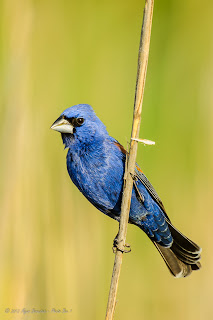 |
| Blue Grosbeak |
 |
| Short-billed Dowitcher |
 |
| Great Egret - breeding colors |
 |
| Raccoon |
For Addional photographs go to
http://www.flickr.com/photos/photobee1/sets/72157624001437150/


 A few facts about the refuge from the government's brochure: " Bombay Hook National Wildlife Refuge was est. March 16, 1937 as a resting and feeding area for migratory and wintering waterfowl. The refuge was purchased from local landowners would Federal duck stamp funds. Today the refuge totals 15,978 acres".


