Showing posts with label Brown pelicans. Show all posts

Friday, April 1, 2016

Ilsa Santa Catalina, Baja Sur, Mexico

I have been continuing to review older folders of photographs that I have taken in finding a great number of pictures that should have processed along with the number of images slightly out of focus or really out of focus that should have deleted.  However, earlier in my life I kept many pictures that I should not have.

Elephant Rock Ilsa Santa Catalina In the Morning Light
I have been working on photographs that I took in 2011 on a trip from San Diego down along the Baja Peninsula and up halfway into the Sea of Cortez.  These trips have been offered for many years by the Searcher Natural History Tours Out of San Diego.  You fly into San Diego and board the boat, and it is a ten day trip with multiple stops, and you fly home from Cabo Mexico.

One of the stops is on the Ilsa Santa Catalina, an island about 13 miles off of the Baja Peninsula in the Sea of Cortez.  The island its rugged and steep with its highest point being about 1500 feet.  There are drought conditions in the Isle, and vegetation is limited to drought tolerant species and cacti.  One unusual creature that lives on this island is the rattleless rattlesnake which feeds on mice that live on the island, which are not found anywhere else.
Cacti On the Island
We approached the island early morning with elephant rock glowing in the sun during the golden hour.  Many species of birds are seen in the isle, including Brandts Cormorant, yellow-legged gulls, great blue Heron and brown pelicans.
Brandt's Cormorant
Brown Pelicans
Yellow-legged Gull
The geology of the area is interesting with green rocks called Olivine,  the name given to a group of silicate minerals that have a generalized chemical composition of A2SiO4. In that generalized composition, "A" is usually Mg or Fe, but in unusual situations can be Ca, Mn, or Ni.

Olivine
Olivine
Scattered along the steep slopes there would be areas with a single plant, and even flowers are growing.
Flowers on the Steep Slope
Part of our group went snorkeling, and the rest of us took a panga ride along the edge of the island where a large number of Sally Lightfoot crabs with scattering all around.  Later on, the day we landed on the island and had a close look at the Flora that grew Catalina.
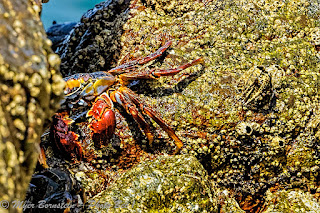
Sally Lightfoot crab
Cacti
If you search my blog files, you will find more information on my trip to the Baja.

Using the coupon code mborn you will receive a 15% discount on any or all of the Topaz plug-ins.


Help Support my blog by purchasing from Amazon. Clicking on this link and utilizing the link does not cost you anything.

Saturday, November 29, 2014

Costa Rica, the Morning of the Third Day

American Crocodile
Continuing the trip to Costa Rica.  My intention was to split the trip into two day segments and blog with this in mind.  However, because the amount of material that I want to present.  I am going to have to do the trip in smaller segments.  This way I can show you more photographs.

Our third morning in Costa Rica, we traveled down to the Tarcoles River where we had a private three-hour trip on one of the crocodile boats.  Because there was only eight of us, plus the driver each of us had a row of seats to ourselves, which made it easy to photograph either to the right and left.  José, the boat captain, is not only a birder but knows how to position the boat, so we have the best chance at photographs.  The Tarcoles River is not only known for crocodiles, and many species of birds and other reptiles but has the distinction of being the most polluted river in Costa Rica.

The trip not only encompass the river, but we traveled down to the river's mouth where it empties into the Gulf of Nicoya, which is part of the Pacific Ocean and also explored the mangrove swamp area.

Besides seeing crocodiles, there was a variety of heron and egrets, yellow-headed caracaras, roseate spoonbills, scarlet macaws and more. Iguanas and other lizards were spotted scampering about the sides of the river.
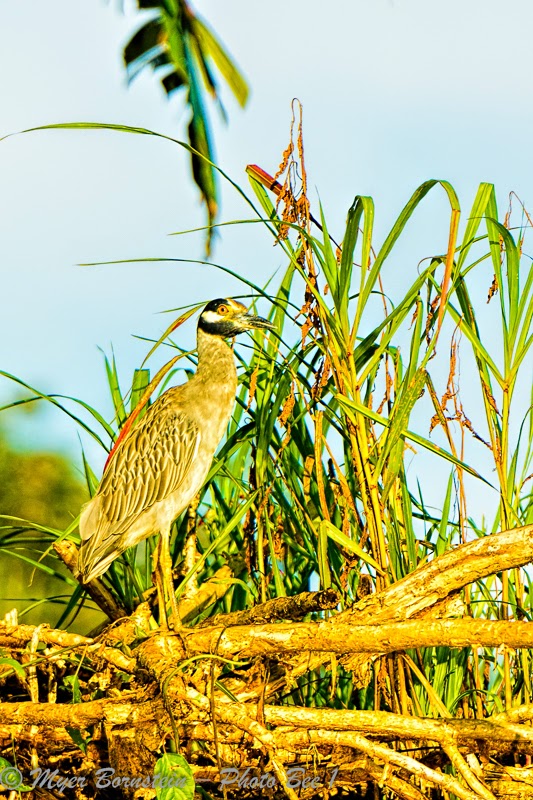
Yellow-crowned Night-Heron
Smoothed-billed Ani
Eastern Meadowlark
Black-necked Stilt
Bare-throated Tiger-Heron
Little Blue Heron
Yellow-headed Caracara
Basilisks lizards
Magnificent Frigatebird
Brown Pelican and Royal Terns
Black Vultures Fighting
Roseate Spoonbill
Ringed Kingfisher
Amazon Kingfisher
Scenic View of the River
After this great trip, we returned to our lodge for lunch and to photograph the birds that were around the grounds, but that is for the next blog.

Help Support my blog by purchasing from Amazon. Clicking on this link and utilizing the link does not cost you anything.
BUY FROM AMAZON

Friday, April 22, 2011

Florida Part Four - Saturday Morning

We had driven over on Friday to St. Petersburg where we were spending the weekend and staying at a Holiday Inn Express. our plans were early Saturday morning to drive to Fort de Soto, however, approaching the bridge leading into the park we were stopped by the sheriffs department because there was a triathlon going on and we could not get into Fort de Soto until after 9:30 AM. So we changed our plans and drove over to Indian Shores will we stopped at Seacoast Seabird Sanctuary and walked out onto the beach. Despite all the people on the beach, there were at least 50 to 75 black skimmers present along with laughing gulls, willets, pelicans and terns.

When I first tried to photograph the birds, I found a big problem; the lens was fogged due to it being all night in our cold air-conditioned room and now it was out in the warm humid air. Here is what the first picture looked like.
 fogged lens, it could have been taken in the fog


In order to get the better pictures, we got down onto the sand and photographed the birds at an eye level. They were mating rituals going on especially the laughing gulls and the Royal terns.

Sandwich Tern

Black skimmer in-flight

Royal terns in-flight
Snowy egret

Black skimmer

flight of black skimmers

willit

Royal terns courtship ritual

Royal terns copulating

One pair of laughing gulls copulated for at least 5 minutes with both of them making a lot noise.
laughing gulls copulating


In the water near the shoreline there was a number of fish jumping and moving around so the brown pelicans were feasting.
Brown pelican fishing

Brown pelican fishing

We then drove back to Fort de Soto and was able to get out on the North Beach where we finished the morning photographing the shore and Wading birds that were present. We photographed most of the birds from the water side, wading up to just below our mid-calf area.

yellow crowned night Heron, it close for us right on the sand

 Willit

marbled Godwit

American oystercatcher

short-billed dowitcher

lesser yellowlegs

white Ibis

Ruddy turnstone

reddish egret


We finished the morning at at the East beach area watching people Para-sailing.

para-sailing