Showing posts with label Juvenile. Show all posts

Thursday, August 8, 2013

Encounter with a Cowbird - Molothrus ater

Juvenile Brown-headed Cowbird - Molothrus ater
During our trip to Sachuest National Wildlife Refuge, Middletown, Rhode Island, while observing some birds in the distance, we had a guest arrived.  A juvenile cowbird landed on the path near us, and then proceeded to walk between by compadre Doug's legs and his tripod.  I had to backup so I could get pictures.  The cowbird was actively foraging for food and didn't care about us.  I even walked up to within a foot of it, and it just kept on foraging.  The cowbird finally flew away.  It was a very enjoyable encounter.
Juvenile Brown-headed Cowbird - Molothrus ater

Juvenile Brown-headed Cowbird - Molothrus ater

Juvenile Brown-headed Cowbird - Molothrus ater

Juvenile Brown-headed Cowbird - Molothrus ater

Friday, August 3, 2012

Three Strikes Out

Great Egret

Thursday is my usual day to go birding with my good friend Doug and our plans were to travel first to Great Meadows national wildlife refuge to try to see the Blackbellied Whistling Duck, and then travel to New England Bio Labs to locate and observe the Redheaded Woodpecker.  Besides Doug and myself, my grandson Kyle was going to go with us because he is turning into a great photographer, and he used to work at the New England Bio Labs and knows the location.
Strike one.
Our plan was to meet at 5 AM, so we could miss the traffic going up group 24 and Route 128.  However, even though I set the alarm.  I did not wake up until 5 AM, I woke Kyle and immediately got dressed and went outside to meet Doug, who was waiting for us.  The trip up to Great Meadows was not too bad.  There was a little bit of traffic, but nothing horrendous. 
Strike two
We arrived at Great Meadow, and the only other person there, a birder said he had not seen the black-bellied whistling duck is yet.  We scouted out the location where the duck is usually seen plus goading all along the whole Dike and down to the river, but by 9:45 AM, there was no sign of the duck.  So we left to go to the New England Bio Labs.  A birder at Great Meadows told us at the New England Bio Labs after you cross the bridge go down the path turn to the right to the next wooden bridge to see red-headed woodpecker (we will discuss this is strike three).  We returned to Great Meadows from New England Bio Labs around 1 PM and stayed until 3:20 PM without any sign of the duck.  Birders who have been there since we had left in the morning had not seen the duck at all.
Strike three.
Arriving at the New England Bio Labs, we set out down the trail across the bridge, turn right at the intersection and went to the wooden bridge.  We saw a number of good birds, but not our red-headed woodpecker.  So after 2 hours, we left, stopped for some lunch and return to Great Meadow.  On discussing what we've had done to find the Redheaded Woodpecker's, a number of the bird is told us we should have turned left rather than right.
I did obtain some interesting photographs.  One of the nicest was a juvenile hooded merganser.  When I first took the picture, I could not identify what the bird was from the bird guides and until I arrived home and looked on the computer and did a Google search was I able to identify which merganser.
Hooded Merganser - Lophdytes cucullatus
Hooded Merganser - juvenile

 _D8C6637 August 02, 2012 NIKON D800
Eastern Kingbird
American bullfrog (Rana catesbeiana )
American Bullfrog
Blue Dasher - Pachydiplax longipennis
Blue Dasher


Blue Dasher - Pachydiplax longipennis
Blue Dasher
Great Blue Heron - Ardea herodias  
Great Blue Heron

Tuesday, April 17, 2012

Red-tailed Hawk Encounters at Allens Pond

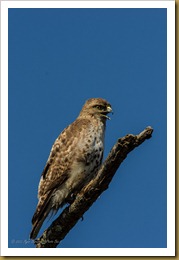
On last Friday's Allens Pond Massachusetts Audubon Sanctuary bird walk, we had a few interactions with juvenile Red-tailed Hawks.  - RTHA_DSC7160 April 13, 2012 NIKON D7000What makes it interesting, is that the juveniles are much less skittish than the adults and do allow close encounters without flying off.
The Red-tailed Hawk (Buteo jamaicensis) is one of the most common buteos in North America, ranging from Weston Alaska and northern Canada to has far south as Panama and the West Indies.  Its scientific name comes from it being first found on the island of Jamaica.  There are at least 14 recognized subspecies, varying in appearance and range.  However, the basic appearance of the Red-tailed Hawk is consistent with the underbelly lighter than the back, a dark brown band across the belly, the tail is uniformly brick-read above and pink below, and it's Bill was shot and dark.  One of the ways to tell a juvenile red-tailed hawk from an adult is the color of its eye.  Juveniles have a yellow iris while adults irises are a reddish-brown hue.

The first encounter with the red-tailed hawk was right at the field station, we were getting ready to start our walk, when we noticed a large brown bird disappear in front of the field station.  At first we thought it was a Harrier, but it didn't appear.  I walked to the side of the field station and in the small tree at the side of the field station, the hawk was sitting.  We will able to get good views of the hawk, it then flew across the street- _DSC7164 April 13, 2012 NIKON D7000 and landed on a railing of a porch where it just stayed for a while.  - _DSC7167 April 13, 2012 NIKON D7000We then encountered another red-tailed Hawk down by the marsh in a tree.  - _DSC7178 April 13, 2012 NIKON D7000
- _DSC7246 April 13, 2012 NIKON D7000And when we traveled to the grasslands portion of the Allens Neck section of the sanctuary.  We found another juvenile red-tailed hawk in an old tree, where it stayed  as we slowly walked by.and were able to get close observation of the hawk. - Yelow iris_DSC7336 April 13, 2012 NIKON D7000- _DSC7344 April 13, 2012 NIKON D7000


Finally, we had a juvenile soaring overhead, as it was searching for food.- _DSC7282 April 13, 2012 NIKON D7000