Showing posts with label Scenics. Show all posts

Wednesday, December 23, 2015

Last Day in the Everglades

River of Grass
Well, the workshop was over.  I had a late flight out on Thursday, so after breakfast that morning.  Gail Chin from Regina, Saskatchewan, who I have been sharing the rental of the car with went back to the Everglades and slowly drove down the main road, stopping to capture what we saw her on the way.  We did scenics and found a cooperative Wood Stork to photograph.
Wood Stork
We finished the day at the Anhinga Trail photographing some different birds.  There were large groups of children from schools being given a tour of the trail and learning about the biology and creatures.  A park ranger was leading up to or and told people over a Causeway with the water was running very fast that if a person fell in they would be dragged all the way down to the Gulf.
Royal Palm Visitors Center
Students
Great Blue Heron
Anhinga
Great Egret
White Ibis
Later on Gail, drop me at the airport and she went to spend a few more days in Miami.  I think I have to start planning a longer trip back down to Florida next year.

Using the coupon code mborn you will receive a 15% discount on any or all of the Topaz plug-ins.


Help Support my blog by purchasing from Amazon. Clicking on this link and utilizing the link does not cost you anything.
BUY FROM AMAZON

Merry Christmas and a Happy New Year to all my readers

Tuesday, September 29, 2015

Flora, Fauna and Macro at Bosque de Paz

Black Guan
Well, sadly, it is our last full day at Bosque De Paz.  We spent the day photographing various flora and fauna and the landscape.  We also had a great time with macro photography, both during the day and at night.  Another thing that makes Bousquet De Paz so great, is the employees. Not only do they do their job, but are always telling us about new birds that they have found so we could see them, and they would also bring subjects for us to photograph.
Yellow Ladyslipper
The River and Falls at Bosque de Paz
Aloe Flowers from Below
Coatimundi 
Black Phoebe
Now how we learnt how to do it.  Because Costa Rica is filled with jungles.  In these areas the light can be dim, partly dark and partly dark to to the sun filtering through the leaves of the trees, which makes the use of flash very helpful.  We used our flash on the camera or on a flash bracket attached to the camera plus a Better Beamer and varied the intensity of the light to give us fill flash and not overpower the natural light.

Normally at home for macro work.  I use dual flashes attached to the lens and they are controlled by a controller on the hot shoe.  Greg taught us how to use off-camera flash, so we could vary the direction the light illuminated the subject.  To accomplish this, methodology included a flash cord, remote flash controllers or if you have a Nikon with a built-in flash, it can be used as a controller for your handheld flash.  Also, a flash the fusion is helpful.  During the day you want to use the flash only as a fill flash where at night the flash power should be  on full  power as it will be the only  illumination.  Also at night, a headlight or LED torch is very useful along with an assistant.  The assistant is used to position the flash.  We used our torches to locate subjects for us to photograph and light up the subject, so we could focus on the subject.  Depending on the subject and which lenses we had, people either utilized a macro lens, a zoom lens or a zoom lens with a Canon 500 dual lens macro filter.  Not only did we use our torches to find subjects, but it also helped us walking on the dark paths.

Now on to pictures!
Caterpillar 
Fly
Katydid
Caterpillar 
Katydid Moulting
Back-lit Cricket
Walking Stick
Owl Moth
Giant Silk Moth
Brown Walking Stick
Spider
Spider
Glass Tree Frog

Tuesday, October 9, 2012

Mount Desert Island - Acadia National Park

I just spent another long weekend at Acadia National Park.  This weekend I joined the Nature Photographers of North America regional event.  This was not a workshop, but unorganized event where professional photographers knew the area would take us to locations in order to help us get the best photographs.  The event ran from Friday through midday on Sunday, with four morning and afternoon events, so the groups would not be too large.  We would all gather at the hotel around 5 AM for coffee and muffins and then start out for the locations so we can arrive there before dawn.
 DSC_0648-Edit October 04, 2012 NIKON D3S
My first trip was to the top of Cadillac Mountain, we started out in heavy fog, hoping when we arrived, the fog would lift and the sun would appear.  However, that was not the case, and no sun rise photograph could be obtained.  We photographed the granite rocks covered in lichens and the asters and other plants that were present.  On the way off the mountain, there was a small waterfall flowing by the side of the road.  Waterfalls only occur after a rain, because of the granite that makes up Mount Desert Island.
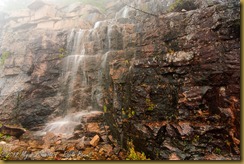
 DSC_0752 October 05, 2012 NIKON D3S
Cadillac Mountain, at 1530 feet, is the highest point on the Eastern seaboard, north of Rio de Janeiro and where  most visitors to Acadia National Park visit either to see sunrise or sunset.
After leaving Cadillac Mountain, we traveled down Duck Brook Road to photograph the beautiful carriage bridge over the brook, the foliage and the rushing water in the brook.  So finished the morning.
 DSC_0772_HDR October 05, 2012 NIKON D3S
After a brunch, everybody gathered for a question-and-answer session and a critique session of photographs that people submitted.
My afternoon's trip was to Bass Harbor Head Light to try to capture the sunset.  Arriving there, we settled ourselves below the lighthouse on the rocks to await sunset.  The clouds was still thick, although there were breaks in the clouds with sunrays coming through the breaks.  But as time progressed, the clouds thickened and we could tell that there would be no sunset.  We left the lighthouse and traveled to Bernard Harbor and photographed the lobster boats in the harbor and the scenics that were around us.  After it got dark went and had supper and then back to the hotel to rest, because tomorrow would be just as early.
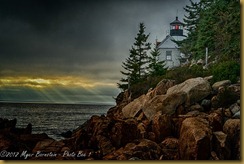
 DSC_0841-Edit October 05, 2012 NIKON D3S
 DSC_0860 October 05, 2012 NIKON D3S
Saturday morning, we met at the same time, and this time I went to Monument Cove.  Guess what, it was still foggy and the distant cliffs were hidden.  There were a number of close scenics to be obtained and I did get the Spire at Monument Cove.
 DSC_0967 October 06, 2012 NIKON D3S
Again brunch that question-and-answer session at critiques and in the afternoon a trip to Jordan pond.  The weather was still extremely overcast with fog and it was hard to get any decent vistas.  It didn't mean that there weren't any photographs to take, just you couldn't show the entire grandeur of the Lake.  We ate supper at the Jordan Pond House, where we enjoyed the nice world-famous hot popovers with butter and jelly along with the rest of our meal.
 DSC_0973 October 06, 2012 NIKON D3S
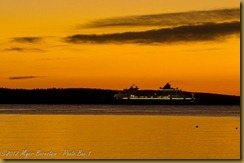
Sunday morning, the stars and moon were out and I travel down with my group to Dorr Point, where were able to photograph, finally, a sunrise.  I was even able to photograph.  One of the cruise ships arriving in the early morning light.
 DSC_4088 October 07, 2012 NIKON D7000
 DSC_4064 October 06, 2012 NIKON D7000
Finished off the weekend with a luncheon and the gathering of all my new friends and hoping to see them in the future.
Acadia is a wonderful place to visit, no matter what the season, and no matter what the weather.  There is always something to do and photograph.  So come visit Acadia In Down East Maine