Showing posts with label Block Creek Natural Area. Show all posts

Saturday, May 9, 2015

Texas Hill Country Finale

This is the final blog about the Texas Hill Country.  The owners of the Block Creek Natural Area, received permission for our group to drive down the road and photograph an old farmstead.  The Ferdinand Hohenberger farmstead was purchased in 1871 and remained in the family until 1915.  It was interesting seeing and photographing the old houses and wagons on the farmstead.  In fact, the main house is still occupied.


The rest of the pictures are some scenes from around The Block Creek Natural Area.  As I said before, this is a great place to visit and the owners, Larry and Sharron will take great care of you.
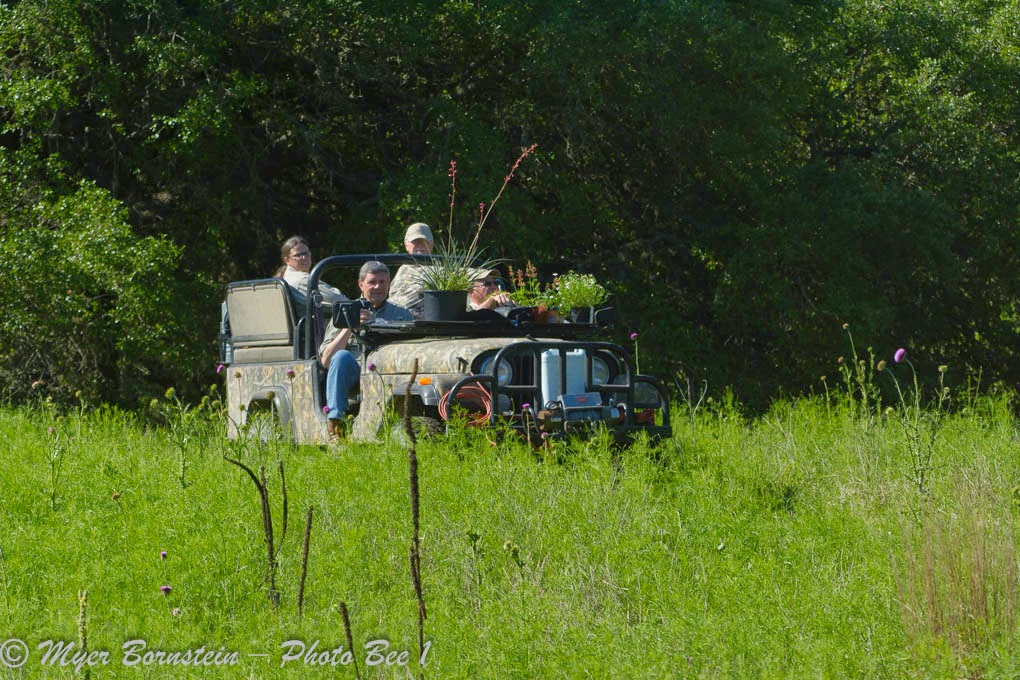
This is how we travel to and from the blinds

we all had breakfast together

another view of the Jeep

part of the porch at the house


Finally, approximately 5 miles up the road is the Last Tunnel State Park, the pack has a half-mile walking trail and you can view the opening to the old railway tunnel.  Right now, what and Park is noted for is that in May through October up to 3 million Mexican free tail bats and 3000 myotis bats fly out of the tunnel and fill the sky.  Because we were photographing until almost 8 o'clock. I was not able to witness this phenomena.  I did create a panoramic of the view from the upper viewing deck at the park.
Panorama of Texas Hill country.


Using the coupon code mborn you will receive a 15% discount on any or all of the Topaz plug-ins.


Help Support my blog by purchasing from Amazon. Clicking on this link and utilizing the link does not cost you anything.
BUY FROM AMAZON

Friday, May 8, 2015

Next to Last

Scissor-tailed Flycatcher
In today's blog is just a summary of some of the other animals that I photographed during my trip to the Hill Country of Texas, at Block Creek Natural Area.  A fox squirrel made its appearance and two of the other participants did photograph a fox.  I did spend time trying to capture purple martins flying and the next succeed, by considering the direction the wind was blowing and observing how the martins were coming in to their house.
Purple Martin in Flight
Purple Martin in Flight. Flying by Windmill
Fox Squirrel
Fox Squirrel
Northern Cardinal
Lesser Goldfinch
Chipping Sparrow
Summer Tanager
black-crusted Titmouse
Canyon Wren Singing
Carolina Chickadee
Inca Dove
Lark Sparrow
Lesser Goldfinch
The next blog will be a summation of my trip and experiences.

Thursday, May 7, 2015

"Number 700"

Brown-crested Flycatcher - Myiarchus tyrannulus.
While in the hill country of Texas, I finally reach 700 life birds: Brown-crested Flycatcher - Myiarchus tyrannulus.  What made this bird, partly easy to see was that its nest was in a cavity in the tree right next to the outside porch at the house and the flycatchers would come and go.
Nesting Tree with Cavity
Tail of the Flycatcher As It Entered the Cavity
Brown-crested Flycatcher - Myiarchus tyrannulus
Information about the brown-crested flycatcher from Cornell Laboratory of Ornithology: "The Brown-crested Flycatcher occupies a variety of woodland and scrub habitats throughout its broad distribution; this species breeds as far north as southern Utah in the United States, and south to northeastern Argentina.  The Brown-crested Flycatcher is a large member of the genus Myiarchus with conspicuous rufous on the tail, two broad white wing bars, grayish-brown upperparts, a pale gray throat and breast and yellow lower underparts.  During the breeding season these flycatchers maintain a diet exclusively of insects and other arthropods.  Brown-crested Flycatchers are more omnivorous during the nonbreeding season when they will eat fruits as well as arthropods.  Brown-crested Flycatchers are migratory at both the northern and southern reaches of their range.  Birds in the United States and northern Mexico migrate south, and winter from central Mexico south to El Salvador. The migratory patterns of the southernmost populations of Brown-crested Flycatcher are not well documented, but they probably winter in the southwestern Amazon Basin."

Distribution Map


Using the coupon code mborn you will receive a 15% discount on any or all of the Topaz plug-ins.


Help Support my blog by purchasing from Amazon. Clicking on this link and utilizing the link does not cost you anything.
BUY FROM AMAZON

Wednesday, May 6, 2015

Black-Chinned Hummingbird (Archilochus Alexandri) photography

During the day, when we were not out photographing in the blinds are and other areas, we had the opportunity to photograph black-chinned hummingbirds.  Larry put a high-speed flash set up, which contained five flashes so we could photograph hummingbirds coming in to feed at a flower.  What made this an easy project is that Block Creek Natural Area, has five feeders hanging around the porch, with greater than 50 hummingbirds present almost all the time during daylight hours.
Black-Chinned Hummingbird At the Feeder
After we adjusted our settings, using an on camera flash, set to command mode plus still providing a flash.  The reason for this two of the flashes utilized a radio signal and three of the flashes were fired by the flash on the camera.  Two of the flashes illuminated the background, and the other three flashes illuminated the birds.  Camera settings were f/22, ISO depending on which camera was being used by the participant, ranged from 200-320, manual on the mode and by pre-focusing on the flower the autofocus was turned off.  The whole setup was mounted on a tripod and by using a wired trigger, you could sit back and fire the camera when the hummingbirds approached the flower.  It was easy photography sitting back in a rocking chair, watching the action, and then firing the camera.

Set up
set up
Male and Female Black-Chinned Hummingbird
Male and Female Black-Chinned Hummingbird
Male Black-Chinned Hummingbird Showing the Purple Stripe on His Throat 
Male and Females Black-Chinned Hummingbird
Even at the setups at the blinds, we were able to photograph black-chinned hummingbirds as they flew in to feed on the flowers.

Black-Chinned Hummingbird Photograph from a Blind
Black-Chinned Hummingbird Feeding on a Flower
Black-chinned hummingbirds are a small, slender hummingbird with a fairly straight bill.  Both male and female color dull metallic green above and don't grayish, white below.  The males have a velvet ugly black throw with a thin, evidence purple base while the females have a pale throat.  The females three out of tail feathers have a broad white tip.

Black-chinned hummingbirds are found in most of the Western United States, parts of British Columbia in Mexico.  They are found in a variety of different habitats: mountains, woodlands, orchards, meadows, and chaparral.

Using the coupon code mborn you will receive a 15% discount on any or all of the Topaz plug-ins.


Help Support my blog by purchasing from Amazon. Clicking on this link and utilizing the link does not cost you anything.
BUY FROM AMAZON

Tuesday, May 5, 2015

Black-bellied Whistling-Duck (Dendrocygna autumnalis)

Feeder Set up
On our first morning, after breakfast, the group divided up depending on what they wanted to photograph.  Two of us went down to the area that had the larger grain feeders, hoping to photograph Tom turkeys displaying and black-bellied whistling ducks, since the previous afternoon we saw Tom turkeys displaying down in this area.  We were driven to the area and after we set up, we waited to see what action would happen.  The first thing, a flight of whistling ducks went over.  A single and Turkey came and fed, but there were no toms.  However, the black-bellied whistling duck gave us good shows.  They flew when and landed both on the ground and on limbs and in trees.

 Black-bellied Whistling-Duck (Dendrocygna autumnalis), is only one of the two whistling-duck species that are native to North America.  Its former name was the black-bellied tree duck.  It is found from southern most United States to tropical central to South-Central South America.

 Black-bellied Whistling-Duck (Dendrocygna autumnalis)

An interesting fact about the black-belly whistling duck is that they usually feed nocturnally, but ours were feeding during the morning hours.  Their food source is usually plant material, arthropods and aquatic invertebrates.  They also will eat leftover grain and feels after harvest..

 Black-bellied Whistling-Duck (Dendrocygna autumnalis) Coming in for Landing in a Tree
 Black-bellied Whistling-Duck (Dendrocygna autumnalis) Big Wings Spread
 Black-bellied Whistling-Duck (Dendrocygna autumnalis) Coming in for a Landing by the Feeder
Black-bellied Whistling-Duck (Dendrocygna autumnalis) Sitting on a Tree Stump
Black-bellied Whistling-Duck (Dendrocygna autumnalis) Sitting in a Tree

Among ducks, the black-bellied whistling duck is unusual as it makes for life.  Both sexes share in the brooding and raising process of the young.  They are primarily nests in cavities, but rarely on the ground.  In areas where mammalian nests predators are absent is when they will nest on the ground, and several females can share the same nest.  Female black-bellied whistling ducks can lay up to 13 eggs.


Using the coupon code mborn you will receive a 15% discount on any or all of the Topaz plug-ins.


Help Support my blog by purchasing from Amazon. Clicking on this link and utilizing the link does not cost you anything.
BUY FROM AMAZON