Showing posts with label bird. Show all posts

Tuesday, April 23, 2013

Bobolink

Bobolink
It is now the start of spring migration and today I want to discuss an interesting bird.  It is a member of the blackbird family - the Bobolink.  What makes the bobolink interesting, it's not only the bobolink's bubbly song, but the color change in the male.  The male undergoes to complete molts every year, when the fresh alternate feathering of the male wears off results in the striking black and white plumage that you see during the breeding season.  After the breeding season is over, the male starts to molt and then looks just like the female.  So in the fall, you cannot tell the male from the female bobolink.
Bobolink Winter Plumage

Bobolink Winter Plumage

Bobolink
Female Bobolink

Bobolink in flight


Bobolink's are found in the summer and agricultural fields, grasslands and meadows.  In southeastern Massachusetts, they can be found at the fields of the Allens Neck trail system of Allens Pond Wildlife Sanctuary in Dartmouth, Massachusetts, and that the Daniel Webster Wildlife Sanctuary in Marshfield, Massachusetts.

Bobolink's were also immortalized by the poem "Robert of Lincoln" by William Cullen Bryant.
"Merrily swinging on brier and weed,
Near to the nest of his little dame,
Over the mountain-side or mead,
Robert of Lincoln is telling his name:
Bob-o'-link, bob-o'-link,
Spink, spank, spink;
Snug and safe is that nest of ours,
Hidden among the summer flowers,
Chee, chee, chee.
........"

Monday, June 4, 2012

Peregrine Falcons in Pawtucket, Rhode Island

 _D8C3016 June 03, 2012 NIKON D800
Adult and Fledgling
I spent Sunday morning photographing a family of Peregrine Falcons in Pawtucket, Rhode Island. I was invited by my friend, Kathleen, whose office is on the 4th floor of her building and has a unobstructed in the view of the tower at Pawtucket City,.  where their nest is located..  The nest box was installed when work on the I-95 bridge was started.  The only problem is that the tower may have to be torn down because of constant leaking.
Pawtucket RI City Hall
Pawtucket City Hall
pawtucket labeled


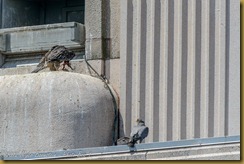
Kathleen's office is located on the 4th floor, which is the location where we photographed the birds from.  A great location, comfortable, with chairs, and no mosquitoes.  The line of sight was clear from the windows to the tower and we were around 300 to 350 feet away from the action.
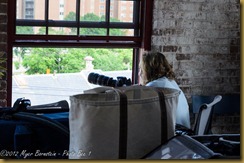
 _DSC2367 June 03, 2012 NIKON D7000 _DSC2368 June 03, 2012 NIKON D7000
For equipment I utilized by 500 mm f/4 lens with a 2X converter and for my main camera my full frame Nikon D 800.  I did utilize my Nikon D 7000 for a few comparison pictures.  Although the D 7000 with its crop factor of I.5 added to the magnification of the picture, the difference in sharpness between the 16 pixel D 7000 and the 36 pixel D 800 is remarkable.
Nikon D800
Nikon D800
Nikon D7000
Nikon D7000


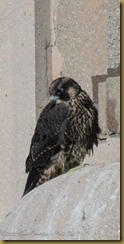
When we started photographing the Peregrine Falcons, all that was present by the nesting box and on the ledge below where the fledglings.  They would hop around, and flapped their wings, eat and rest.
 _D8C3235 June 03, 2012 NIKON D800
The adults did make an appearance.  The female Peregrine Falcons went and rested on a projection just below a large carved eagle on the tower.   _D8C3141 June 03, 2012 NIKON D800


The male bird flew off and disappeared for almost 2 hours.  Later, the female took off and disappeared, probably hunting for food. 
Peregrine FalconPeregrine Falcon


Peregrine Falcon
Female peering nto the "Looking Glass"
Finally just as we were packing up and going to leave, the admirals returned and brought food and there was a lot of activity.  It took me all of 30 seconds to unpack my dear and set it up to take pictures of the new activity.


Male Peregrine eating the gave rest of the prey to a fledgling.
Pawtucket RI City Hall
Peregrine Falcon
The size difference between the male and female Peregrine falcon was large, and the male had more of an all white breast compared to the female.  This could be secondary to the recovery efforts that were instituted to recover the Peregrine Falcons from in endangered species by utilizing captive birds and non-native subspecies into the breeding stock.
Peregrine Falcon
Peregrine Falcons have taken to the urban landscape, and nesting on cathedrals, when the ledges of skyscrapers and towers along with suspension bridges.  So when you are out and about, keep your eyes peeled the sky to look for this extremely fast flying falcon.

Thursday, February 23, 2012

Pied-billed Grebe

The Pied-billed Grebe Pied-billed Grebeis another bird that was very interesting to observe and photograph during my Utah trip.  They were located at the Farmington Bay Waterfowl Management Area, swimming around with American Coots.  They are the sole member of their genus and are distributed throughout North America, Central America, the Caribbean and temperate South America.
Pied-billed Grebes are found on open waters, including ponds, marshes and sluggish streams.  They are very rare on salt water.  Pied-billed Grebes are not strong fliers and usually escape from danger by diving.  They have a very short thick bill which has a black ring around it  In the summer. Pied-billed Grebes also are the only grebe that doesn’t have white wing patches. Their diet consists mainly mainly of aquatic invertebrates, and also on small fish and amphibians (frogs, tadpoles). During the time that I was observing the Pied-billed Grebes, they were either swimming, diving for food or resting.  I did see one Grebe capture a large fish (for it), which it eventually swallowed.  An American Coot kept It's eye on the Grebe, hoping that it could obtain the fish from the Grebe.Pied-billed Grege- _ROT7427-Edit February 18, 2012 NIKON D3S - Copy- _ROT7433-Edit February 18, 2012 NIKON D3S - Copy- _ROT7442-Edit February 18, 2012 NIKON D3S- _ROT7443-Edit February 18, 2012 NIKON D3S
Even though I was sitting on the bank low on the ground and close to the water, did not seem to bother the grebes as they went about their business.  Another interesting observation is that when they dive, they will travel a great distance.  On the water before they surface.- _ROT7516-Edit February 18, 2012 NIKON D3S- _ROT7518-Edit February 18, 2012 NIKON D3S- Pied-billed Grebe_ROT6147 February 17, 2012 NIKON D3S
As I have said in other posts, sitting still and observing will make the birds less afraid and you can learn how they go about their normal activities.

Thursday, January 12, 2012

Belted Kingfisher

- Belted Kingfisher _BIF8766 March 09, 2011 NIKON D3S
Male Belted Kingfisher
The Belted Kingfisher is a beautiful bird and is one of my nemesis.  The reason for it being an nemesis, is that it is hard to get close to photograph it. Even sneaking behind bushes being low to the ground, the Kingfisher seems to know that you are there, screech and fly off.  I have however been able to get some pictures over the last couple of years.
- ROT_1959 January 02, 2012 NIKON D3S
Female Beltedkingfisher on watch
Kingfishers are distributed across most of Canada, Alaska, United States, and they are found near bodies of water, where they can find their food, including fish, amphibians, crustaceans, and even small mammals.  The male belted Kingfisher breast is not as brightly colored as the female.  The female has a rufous band across the upper belly.  You will find them sitting on a prominent branch on trees, post or other watch points close to the water, where they can plunge into the water headfirst after their fish prey.  They will also be seen hovering over bodies of water, just like some hawks also do looking for prey.


- - DSC_8963 December 06, 2010 NIKON D3S December 06, 2010 NIKON D3S
Hover
Belted Kingfisher
Taking Off after fish
- Kingfisher flight ROT_1962 January 02, 2012 NIKON D3S
Flight
- Kingfisher flight_BIF8773 March 09, 2011 NIKON D3S
Flight
- - DSC_9006 December 06, 2010 NIKON D3S December 06, 2010 NIKON D3S
On Watch


- Kingfisher looking over shoulderDSC_9000 December 06, 2010 NIKON D3S
Looking over its shoulder
So, when you are around ponds, lakes, streams and other bodies of water, keep your eye open for this most beautiful bird and watch It's interesting behavior