Showing posts with label American Mink. Show all posts

Tuesday, October 20, 2015

Yellow-rumped Warblers Have Returned

Song Sparrow All Fluffed up in the Cold
Yesterday on the coldest morning since April of this year, we traveled down to Sachuest national Wildlife Refuge.  When we arrived, the sun was shining and there was only a few clouds in the sky and there was hardly any wind, which was great, so there was not a lot of windchill.  Walking along the Ocean Loop, there was a number of song sparrows moving around and when we looked out at the ocean, one of the rocks was loaded with cormorants.  In the fields way up at the tree line, there were a few doe white-tailed deer present.
Double-crested Cormorants
As we walked the loop, we encountered a large number of yellow-rumped warblers.  Yellow-rumped warblers are the most common winter warblers and many overwinter in New England.  The reason that they can do this is that they are able to eat berries such as poison ivy, juniper, bayberry and wax myrtle to name a few.  They are easily recognized by viewing its yellow rump patch as it flies away from you and its check call.  In the winter its colors are subdued.
Yellow-rumped Warbler in Winter Plumage
In spring migration.  The colors show a bright yellow charcoal gray and black and bold white markings.
Yellow-rumped Warbler in Breeding Plumage
As we were walking along a path, I felt something was looking at me, and when I turn to my left and the bushes, a deer was staring at me.  It was holding very still.  In fact, Jenna asked is it fake.  Then it wiggled its ears and she knew it was real.  Further behind this deer, there were two more deer present.
White-tailed Deer, Peering through the Bushes
What surprised us was the lack of seabirds in the waters around this refuge.  We only saw one pair of eiders.  Only other birds on the water were gulls and cormorants.

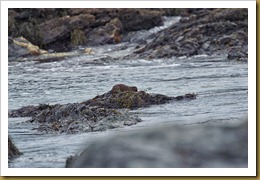
While we are at the viewing platform at the Island Rocks, a mink showed up and though it was at a longer distance than I would have liked.  We were able to get some photographs of the mink coming out of the water and shaking off the water.
American Mink
American Mink

Sunday, May 17, 2015

"Faster Than a Speeding Bullet,"

American Mink - Neovison vison "I am looking for you"
For the number of times I have been down to the Cape Cod Canal, I have not seen The American Mink that roams along the shore, among the rocks.  The other day I went down with the intent in mind of seeing and photographing the mink.  The mink has been usually found around the fishing dock, so that's where we planted ourselves to observe the shoreline.  The shore of the canal is made up of many large boulders, which gives the mink places to hide and also to have a den.  Makes can have a home range, which size can range from .6 of a mile to 3 3/4 of a mile.  Makes run by abounding gate and can go with us speed up to 4 mph.  What makes it harder to photograph from that they will also snake under the rocks and even reverse directions so they come up behind you, rather than in front of you.  Because of the large number of fish in the canal, minks have a ready supply of food.  Minks will dive to depths of 12 inches lasting from 10 to 60 seconds.  Besides fish.  Minks will feed on rodents, crustaceans, amphibians and birds.  Besides, swimming, they also can climb trees.
American Mink - Neovison vison

American Mink - Neovison vison

American Mink - Neovison vison going fishing

American Mink - Neovison vison swimming with a fish

American Mink - Neovison vison
fish in the water of the canal
American Mink - Neovison vison out of the water

Friday, January 6, 2012

American Mink at Sachuest

I travel down to Sachuest National Wildlife Refuge yesterday with the main purpose of viewing the snowy owl, that is present There.  However, my nicest sighting was an American Mink.  I have on occasions in the past seen the American Mink at the refuge, but the sightings were just fleeting.  At this visit, I was able to watch the Mink, swimming in the water and catching food.

Here is some information about the American Mink.  The American Mink, can be found in most of the Continental United States and Canada, except for Arizona, Southern California, Southern and Central Utah, southern New Mexico and western Texas.  It is a member of the weasel family, with a long, sleek body that can be approximately 2 feet in length.  It has short legs and slightly webbed feet and a long, thick tail.  The coloration of which fur is brown to black and it does have white fur on its chin.  The for is covered with orderly guide his that helps make the coat waterproof.  The Mink is a kind of for and will eat rabbits, mice, chipmunks, fish, snakes, frogs, and birds.  It is a very good swimmer and can dive as deep is 16 feet, and in the winter months will be found near the water, where it can catch fish.  The rest of the year.  It does spend the time near the water, but will forage both on land and in the water.

I observed the Mink going from rock to rock jumping in the water and coming out with food to eat.  It did come up on the shore and approach close to me, stopped and looked at me for a minute and then disappeared.  While it was close to me.  It didn't say still enough to allow me to get a close-up photograph.  All my photographs were taken with the hidden behind the large rocks on the shoreline.- ROT_2301-Edit January 05, 2012 NIKON D3Syou can see the rock I was hidden behind
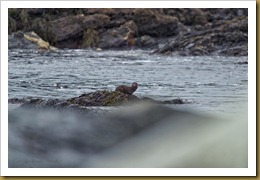
- Mink ROT_2327 January 05, 2012 NIKON D3S- ROT_2309-Edit January 05, 2012 NIKON D3S- ROT_2317-Edit January 05, 2012 NIKON D3S- ROT_2330-Edit January 05, 2012 NIKON D3S- ROT_2334-Edit January 05, 2012 NIKON D3S

I have also seen Mink along the shoreline of the New River in West Virginia, during a boating trip down the river, we were mainly looking for birds.