Showing posts with label Massachusetts. Show all posts

Friday, May 20, 2016

Barn swallows Gathering Mud

Barn Swallow Gathering Mud
Today my son and I traveled to Erwin S. Wilder Wildlife Management Area in Norton.  The idea was to hopefully to some macro photography since last year there was a good number of different species of plants, flowers, butterflies and insects to photograph at the side of the parking lot.  However, the share at least so far.  There were just some buttercups and dandelion seed heads present.  What turned a not so good photography morning to a more excellent one is that I noticed near where the car was parked there were barn swallows gathering mud and pieces of plants to bring to their nest.  Three years ago, I wrote a blog on the barn swallows building their nest at the Stone Barn in Dartmouth, Massachusettshttp://photobee1.blogspot.com/2013/05/barn-swallows-nest-building-at-stone.html

Today gave me the chance to photograph the barn swallows gathering the mud.  I set up my camera D 500 and my lens 200-500 on the tripod and focused on the swallows as they gathered mud.  I then attached my wired remote to the camera and focused where the birds were gathering the mud and then I went away from the camera behind the back of my car and used the remote to fire the camera as the birds came in.  In between the times when the swallows were there.  I changed focal lengths so I would gather more of the scene and hopefully be able to capture the swallows flying off.
Barn Swallow Gathering Mud
At one point, rather than the pair of swallows coming in, three swallows were flying around, while one swallow came in to gather the mud and the other swallow chased the new intruder till it left.


For those readers of my blog who are video photographers, Think Tank Photo have just released the first three in a new series of bags built specifically for professional video.  The largest of the new Video Workhorse series, the Video Workhorse 25,  holds professional camcorders or video camera rigs up to 25” (63.5cm) long and 9.1” (23cm) tall, which could include a camera body, lens, monitor, viewfinder, 4K recorder, audio recorder, medium LED lightpanel, shotgun mic, lavaliere mics, rails, follow-focus, matte-box, shoulder mount, top handle, and cables. The shoulder bag holds a Canon C-series, Sony FS700, FS5, FS7, F5 or F55, Red Epic/Scarlet, Black Magic Cinema Camera, Ursa or Ursa Mini, or a DSLR/Mirrorless rig such as the Sony a7sII, Panasonic GH4, or Canon 5DMIII.  And, as always, you receive a free gift with your order and free shipping.
 https://www.thinktankphoto.com/collections/video-workhorse-series?rfsn=141065.35773

Wednesday, May 11, 2016

Busy Day

Great Egret prior to losing the fish
 
Monday was a very busy day. As in my previous blog, I started out at midnight photographing the nights sky for a few hours. Came home and downloaded the pictures and rested. Then I put together all the material for the talk that I was giving that evening for the photography group at the Newburyport Art Association. We traveled up earlier in the afternoon prior to the meeting and visited Parker River national wildlife refuge and photographed the birds. One of the most interesting events was watching a great egret fishing for food in the pannes. I saw a couple of events that I had not seen in previous observations of great egrets. The first event was the egret, after catching a fish, dropped it and lost it so it had to continue fishing. I have seen other wading birds spreading their wings as they finished, but not great egrets. In fact, this great Egret only spread one wing as it fished. Finally, the egret caught another fish and this time was able to eat it.

Great Egret with one wing spread fishing

Great Egret Fishing Sequence

Great Egret Fishing Sequence

Great Egret Fishing Sequence

Great Egret Fishing Sequence
 
What made the afternoon interesting that there was an intermittent very strong wind that at times would almost blow me off my feet, which meant definitely. I had to use my sturdiest tripod to keep the camera and lens steady.

After a supper at the Black Cow restaurant in Newburyport, which served an excellent meal, good portions and very tasty, I went and set up at the Newburyport Art Association and gave my talk about photographing coastal brown bears in Alaska. The talk was well received, I will be happy to present it for any local camera clubs.

After arriving at home, since my son was not able to join us photographing the night sky early in the morning, we all went out again so that he would have a chance to photograph the Milky Way. I had a chance to try out my new Rokinon 8 mm fisheye lens.
Night Sky Taken with a Fisheye Lens
 

Monday, May 9, 2016

Finally!

Galactic Center Rising at the Stone Barn
The weather gods cooperated, the night sky this morning was beautiful and clear except for a rare cloud.  Although the peak of the meteor showers past three days ago, I was hoping that we could capture some in this beautiful night sky.  We started off at the Stone Barn property of Allens Pond Massachusetts Audubon Sanctuary.  Though the galactic center of the Milky Way was just starting to rise, but it was hidden mostly by the trees.  Scorpius was very visible, along with Mars, which was very near the constellation and to the left of Mars was Saturn. While we were at the Stone Barn, we only observed one meteor.
Night Sky
We then traveled down to Gooseberry, with the Milky Way galactic center present in all its glory.  Directly over our heads, was the big dipper, pointing to Polaris and then on to Cassiopeia.
Milky Way at Gooseberry
It was an enjoyable night to be out, finally, it was not too cold and no mosquitoes present as yet.  Since we are just past the new moon.  This is a great time to see and photograph the Milky Way.  The Milky Way galactic center is rising from the southeast between 11-12 o'clock.

Today's photos were taken with a Nikon D810, Rokinon 14 mm F/2.8 lens on a sturdy tripod, 30 seconds and ISO, varying between 1600 and 2000.

Saturday, May 7, 2016

More on the Nikon D500

Great Blue Heron
The Nikon D500 is an excellent camera.  But, it is complicated and does take the time to learn all its nuances.  In fact, Nikon has published two manuals for this camera.  The first manual is the standard overlooking all law knobs and controls that make up the camera and the second manual just deals with all the settings in the custom menu.

While browsing Facebook this morning, I saw an article talking about the Nikon D5 and it is focusing.  I went to the home page of https://www.facebook.com/richardwildlife/?ref=br_rs and then went to his blog site http://www.richardcostin.com/articles/nikon-d5-review-diary/.  The one item I did not read was what settings did he use for autofocus.  However, I asked the question on his Facebook site, and Richard kindly answered me with what settings to utilize.  He recommended using" mostly AFC dynamic 153. The standard dynamic modes are very trustworthy!"

Although today was overcast, foggy and intermittent drizzle.  I traveled down to Plymouth, Massachusetts and visited both Jenny pond and Nelson Beach, where I tried out the settings.  Because the light was uniform,  I set my camera manually at 1/1250, F/5.6, ISO 1250 with the exposure meter set to +1.  I use the AFC dynamic range of 153.  The majority of my pictures of birds in flight were sharp, and the noise was quickly taking care of and processing.

For the wildlife photographer, the Nikon D500, I believe will become standard in its use.
Mallard Landing
Herring Gull Landing
Ring-billed Gull in Flight

Thursday, May 5, 2016

New Life

Cygnet
The kids and I went out photographing yesterday and the fun part was photographing a family of goslings and a family of cygnets.  The interactions between the adults in the youngsters was interesting.  The Canada geese, adults, both monitored their goslings while the mute swan female was in charge of the cygnets.  The cob mute swan job was to protect them and he spent his time chasing Canada geese.  Nobody got hurt in the interactions.  The one thing we can hope for is that the little ones have a chance to grow up.  The biggest problem is in Jenney pond, there is a large snapping turtle that lives there and in previous years decimated the population of cygnets.
Goslings
Cygnet
Mute Swan With Her Cygnets
Mute Swan Cob Chasing a Canada Goose Who Is Trying to Protect Its Goslings

Do not forget the Topaz special sale that is offering $200 discount on the full Topaz photography collection.  You must use the coupon code SPRINGSUMMER2016  http://www.topazlabs.com/aff/idevaffiliate.php?id=850&url=http://www.topazlabs.com/store

Sunday, May 1, 2016

Blue-gray Gnatcatcher (Polioptila caerulea)

Today I was supposed to meet some participants in the NANPA Great Meadows National Wildlife Refuge meet up.  However, no one showed up.  While I was waiting in the parking lot, my friend Mike came and what he told me was about a blue-gray gnatcatcher nest in the tree by the parking lot.  He identified it for me, and I was able to visualize it.

We walked down the dike path where there were some Canada geese with goslings along with the usual suspects of-red-winged blackbirds and tree swallows.  We saw one Marsh Wren, who was flitting low in the reads and did not present itself for a photograph.

Finally, we returned to the parking lot where we met another colleague and set up hopefully to photograph the gnatcatcher's, around the nest.  First, if you did not know there was a nest there, you would think you would just looking at a lump on a branch.  The knot catches were flitting around and also chasing chickadees and woodpeckers away from their nest.  Finally were able to photograph the gnatcatcher's coming to the nest and continuing to modify the inside of the nest.


Blue-gray gnatcatchers can build a few nests during the breeding season.  It usually will take them up to two weeks to building their nest.  The gnatcatcher's bill, their nest out of lichens and spider webs.  Both the male and the female blue-gray gnatcatcher's help with the construction of the nest.

If you visit Great Meadows National Wildlife refuge-Concord portion, the nest is on the edge of the parking lot in the trees near the observation platform.  Keep your eyes open and you can visualize the birds flying around and in the nest.

As I would say I thank my friend Mike for showing me the nest, because otherwise I would have never noticed it.

Friday, April 29, 2016

Osprey at Nelson's Beach

If you are lucky enough to be in the right place at the right time, then you have a greater chance of getting interesting photos.  The kids and I went down to Plymouth today, first starting off at Jenney Pond, where the Black-crowned night-herons were visible and interacting.

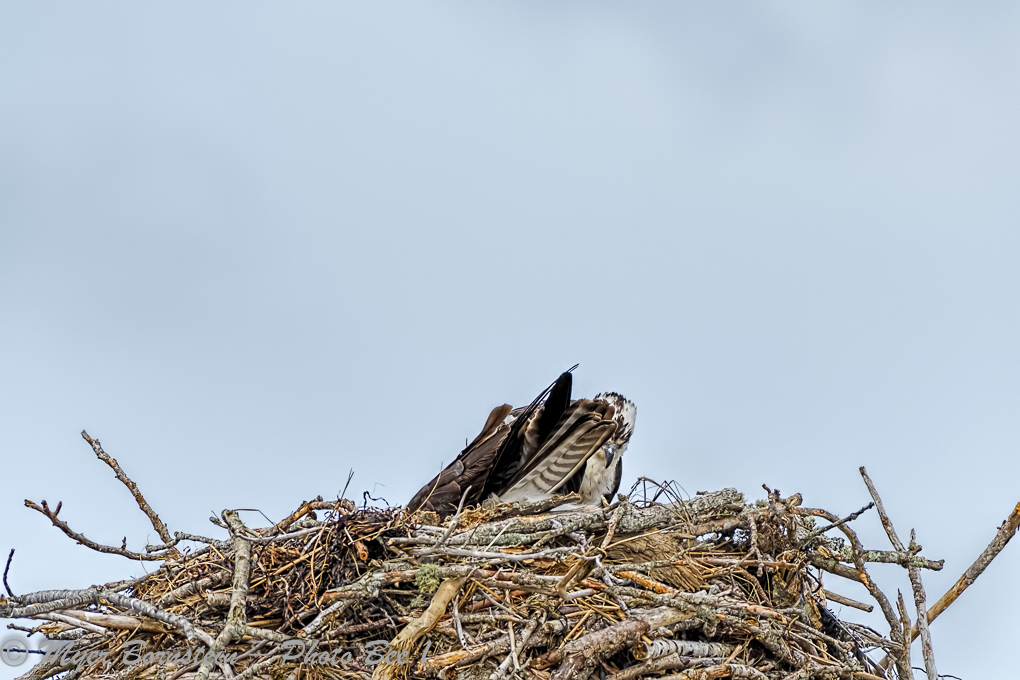
Next, we tried the Harbor, but because of construction, there was not anything interesting going on there.  Next stop was Nelson's Park, where we met up with the friend of mine lender.  While the kids were traveling down along the beach photographing the gulls, and other action going on Linda and I was set up near the Osprey platform and nest.  Hunker down in the nest was one Osprey and way across the way, in a tree was the second Osprey.   Its mate was on the nest as we continue to watch the male, it suddenly took off and flew toward the nest carrying a portion of fish.  The Osprey landed on the nest and deposited the fish for its mate who grabbed a the fish and then flew off to enjoy the meal.  The Osprey, who landed took over the brooding of the eggs that are in the nest.  This interaction gave a great sequence of photos, which were right on, focused.  I utilize my Nikon D 500+ a Nikon 200 to 500 at 500 mm F/5.6, 1/1250 and auto ISO.


As I said we were there at the right time and in the right place, and thankfully the wind was blowing toward us, and so the Osprey came in facing us to the nest.  If the wind were in the opposite direction, We would have needed to be on the other side of the nest.  The other item that was good that it was mainly cloudy and we did not have to worry about the direction of the sun.

What makes Nelson Beach a great place to photograph Osprey is the location of the nest and the Osprey are use to people.

 Remember birds will land into the wind and also will take off into the wind and with the clouds,  We did not have to worry about sun angle.  Remember when you are photographing sun, and wind direction is imperative into way you place yourself to photograph birds in flight

Wednesday, April 27, 2016

Oops! And Lesser Yellowlegs

How it happened, I do not know.  But I can tell you do not try to take pictures of birds in flight or action shots with your camera set on bracketing.  I was out photographing with my D 500 and for the first photos,  everything was fine and until I came home and downloaded the pictures I found that I somehow turned on the bracketing mode and shot a  large number of photos that were bracketed.  Because I was shooting in manual and auto ISO.  I found that usually only one picture in the set was in focus.  If I chimp the lot, I probably would have found this out sooner than arriving at home.  I missed out on some exciting sequences because of this.
Set of bracketed photos
There was a pair of lesser yellowlegs chasing each other over the pannes, which would have made a great series.  Thank goodness there were salvageable photos.
Lesser Yellowlegs Chasing a Lesser Yellowlegs

Friday, April 22, 2016

Earth Day 2016

Sunrise over Buzzards Bay
Today is the celebration of Earth Day; Landscape Photo Magazine had a project to celebrate Earth Day.  The project is for people all around the world to photograph sunrise at their location.  We went to my favorite spot for sunrise, which is Gooseberry Neck in Westport, Massachusetts because it usually has great color in the sky.

Well, today there was some color at the horizon, which was muted due to the clouds and low fog bank at the horizon over Buzzards Bay.  In fact, you barely could see Cuttyhunk.  Despite that the clouds I did produce some images.
Sunrise over Buzzards Bay

For all you photographers try to get out today and capture some photos of our Mother Earth to help honor it.


Using the coupon code mborn you will receive a 15% discount on any or all of the Topaz plug-ins.


Help Support my blog by purchasing from Amazon. Clicking on this link and utilizing the link does not cost you anything.