Showing posts with label Tamarac Park. Show all posts

Sunday, May 22, 2016

Just Sitting

Eastern Kingbird
Yesterday I revisited Tamarac Park in Lakeville and after walking around, I noticed in the dead tree, high up there were some birds.  Near the tree was a pension table, so I decided to sit down and see what birds were up in the tree.  There were Cedar Waxwings and after they left a tree swallow landed and started preening.  A truck pulled into the parking lot, and a nice gentleman came up and asked if he could get some advice on his photography.  Of course, I said I would be happy to.  So he went back to his truck and brought his camera and lens up and sat down next to me.  The hardest part was he had a Canon camera and lens.  Why this was hard is I do not know all the bells and whistles on using a Canon camera.  Talking about settings, that is easy because the settings for the exposure triangle are the same no matter what camera you are using.  He wanted to know a little bit about manual exposure, so we talked about how I do it.  He learned out how to set manual settings on his camera and then learned how to use the histogram to help them refine the picture.  As we were talking, I found out he is only shooting JPEG, but he wants to learn how to shoot in raw and then process the pictures in Lightroom.  Looking at his camera LCD screen, He had good looking pictures.  He is off to a trip to Canada next week, and when he returns.  We will plan to get together so he can learn how to use Lightroom.  Meanwhile, birds were flying by and in between talking, I was able to photograph the birds in flight.  I must say my Nikon D 500 and Nikon 200-500 lens grabbed focus quickly, enabling me to capture the shots.  All this occurred while sitting on a bench, enjoying good company and a beautiful sunny day with lots of activity and bird songs all around us.
Tree Swallow Preening
Brown-headed Cowbird
Great Blue Heron
When I reviewed my pictures on the computer, I got a surprise, the pictures showed many small insects flying around the birds that were perched at the very top of the tree.
Cedar Waxwing

Tuesday, September 1, 2015

Interesting Facts

Returning from photographing the sunrise yesterday, after downloading and preparing yesterday's blog, we went out to do a little bit more photography at Tamarac Park.  One reason was to see if the snapping turtles hatched yet.  No, they have not hatched, I am hoping they will hatch before I leave next week for Costa Rica.

In the kiosk at Tamarac, they have posted my print of Dragonflies and Damselflies of Tamarac Park.
 As we were checking out the meadow, I came across a leopard frog.  First picture shows how they hide and why it may be hard to see them.  The second picture is of the leopard frog as it jumped more into the open.  I remember that leopard frogs scientific name used to be Rana pipiens, but after going online, it turned out that it scientific name has been changed to Lithobates pipiens.  First interesting fact.
Why Leopard Frogs May Be Hard to Find
Leopard Frog in the Open
Walking down toward the marsh, a blue butterfly fluttered around and first landed on my shoe.  It then landed on a leaf.  Here comes a second interesting fact.  Early in the spring, if we saw this butterfly it would be called a spring azure.  Now late in the summer we call them summer azure.  Now, if you Google summer azure and depending on which article or site you read, the scientific name of the spring and summer azure are the same or they are different.  Even the entomologists have a difficulty making up their mind.  One thing is certain the spring azure scientific name is Celastrina ladon.  Now the summer azure scientific name could be either Celastrina ladon or Celastrina neglecta.  Other folks feel they are all part of the same complex.  No matter what, they are a beautiful butterfly to observe and photograph.
Summer Azure
Summer Azure
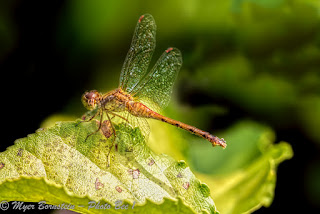
Ruby Meadowhawk Dragonfly - Sympetrum rubicundulum are another interesting species.  There is some Odontologists who believe that there are three forms, and they should be called Jane's Meadowhawk.  The males of the Ruby Meadowhawk have a bright red abdomen with black marks on it while the females and immature males have a yellow abdomen that becomes drab olive-brown or dull reddish in older females.  I did find an older female that showed the dull reddish color and in a second view what was interesting was there a tiny loper caterpillar on its tail.
Female Ruby Meadowhawk

Female Ruby Meadowhawk with Caterpillar on Tail

Remember, always keep learning.


Using the coupon code mborn you will receive a 15% discount on any or all of the Topaz plug-ins.


Help Support my blog by purchasing from Amazon. Clicking on this link and utilizing the link does not cost you anything.
BUY FROM AMAZON

Tuesday, August 18, 2015

Black and Yellow Mud Dauber - (Sceliphron caementarium)

Black and Yellow Mud Dauber - (Sceliphron caementarium) are and interesting wasp.  They are black and yellow colors make him stand out and unlike some other wasps and hornets they are not aggressive.  If you do not threaten them.  What makes them interesting is their lifecycle.  Black and yellow mud Dauber build a series of horizontal tubes on an overhang that is sheltered.  Into each of the tubes they will insert a number of spiders, that they caught, stunned and paralyzed, to be food for the larvae that comes from a single egg that they place and each to.  When the egg hatches the larvae feed on the spider and then will pupate and winter overnight and hatch out in the spring to start the cycle all over again.
Black and Yellow Mud Dauber - (Sceliphron caementarium)

Black and Yellow Mud Dauber - (Sceliphron caementarium)

Black and Yellow Mud Dauber - (Sceliphron caementarium)

Black and Yellow Mud Dauber - (Sceliphron caementarium)

Almost every time I go out photographing I learn something new and interesting, and this maintains my interest in our natural world.

Wednesday, August 5, 2015

Tamarac Park, Lakeville, Massachusetts

For all of those who have been following my blog, knows that I like Tamarac Park in Lakeville, Massachusetts as a great place not only for macro photography, birdwatching and viewing nature.  I was there today to photograph changes that were occurring.  The best news, the friends of Tamarac, or cleaning out invasive plants and will plant native species and clean up the area.  Tamarac has place for everybody to enjoy from nature lovers, photographers, families and fishermen.  To me.  One of the big problems is that people leave messes behind, bottles, paper and all sorts of debris.  Hopefully as the area gets cleaned up and improved that the spoiling of the natural beauty by humans of discarding "crap"..
Cleaning out the Invasive
Plot Plan for Tamarac
The variety of wildlife seen today was immense.  Many different species of dragonflies, including Halloween Pennant.  The wild sumac flowers were blooming and pokeberry (poke weed) are forming.  In the shot.  Of time that I was there I identified at least 14 different species of birds.
Halloween Pennant - Celithemis eponina

Halloween Pennant - Celithemis eponina
Slaty Skimmer - Libellula incesta
dragonfly
Sparrow
Sparrow
Sparrow
Sumac Flower
Pokeberry
Tamarac Park is a long route 105/18 in Lakeville, Massachusetts, headed south and is at the backside of Long Pond and across the road from Assawompset.  As I've said before a great place to visit and to enjoy.


Using the coupon code mborn you will receive a 15% discount on any or all of the Topaz plug-ins.


Help Support my blog by purchasing from Amazon. Clicking on this link and utilizing the link does not cost you anything.
BUY FROM AMAZON

Saturday, June 6, 2015

Snapping Turtle (Chelydra serpentina) Building a Nest and Laying Eggs

Close-up of a Snapping Turtle Eye and Mouth
We spent an interesting morning at Tamarac Park, Lakeville, Massachusetts.  Originally my idea was to do some more macro photography.  However, we found two snapping turtles (Chelydra serpentina) walking up the  path, at the park.  We took photographs of them making their way up the path and then decided just to watch, because I felt that they were going to find a location to dig their nest and lay eggs.  One of the snapping turtles disappeared for a short time and then started walking back down to the marsh.  The second snapping turtle first went into the grass on one side and then walked up to the small grassy hill and started to dig a nest.  The snapping turtle apparently felt in the first area that she choose was too hard for a nest, so she gave up and traveled further up the hill until she came to where a small tree was growing.  The one thing I noticed both at the new place in the old site was that the snapping turtle seem to snuff the ground to tell an area to select.  The snapping turtle started digging, first with her front legs and claws and then turned around and dug the nest hole with her hind feet and claws, alternating sides.  She continued digging deeper and deeper until the hole was deep and large enough.  Egg laying then began, the snapping turtle would release wanted to wear eggs and then they would be placed into position by the snapping turtles back feet.  Although, I did not count every egg being laid the snapping turtle laid at least two dozen ping-pong ball size leathery eggs.  After finishing Lane the eggs, the snapping turtle then refilled the whole with the dirt that was removed utilizing her back legs and claws.  When finished, off back to the swamp, the snapping turtle went.  The whole episode from the start of the final location for the nest to the finish took about two hours.  It was a fascinating site to watch.  Snapping turtle eggs take 80 to 90 days to hatch.  It depends on the temperature.  The interesting fact is at a temperature of around 68°, the eggs will produce only females.  Eggs that range in the 70 to 72° range, who produced both male and females and those eggs incubated at 73 to 75° will produce only males.
Snapping Turtle Trying to Dig out the First Nest
Snapping Turtle, Leaving the Attempt
Snapping Turtle Looking for a New Site
Snapping Turtle, Sniffing the Ground to Choose the Site for a New Nest
First, the Snapping Turtle Starts Digging with Its Front Claws
Then the Snapping Turtle Uses Its Back Claws to Dig the Nest
Front View of the Snapping Turtle Digging the Nest
Snapping Turtle Continuing to Dig
Snapping Turtle Getting Ready to Lay Eggs
Snapping Turtle Laying Eggs in It Uses Its Rear Claws to Pack Them into the Nest 
Snapping Turtle Filling the Hole. After All the Eggs Were Laid
Final Result


Wednesday, August 13, 2014

Harvestmen or Otherwise Known As " Daddy Longlegs"

Harvestman, notice how long it's legs are
Harvestman, Notice the fused body regions and the single pair of eyes
Most everybody have seen harvestmen, especially because of their long legs, and think they are spiders.  Harvestmen belong to the same Family of arachnoid as spiders, but belong to a different order Opiliones.  Some of the characteristics that separate them from spiders are fused body regions and a single pair of eyes in the middle of their cephalothorax.  There is a legend that harvestmen is the most venomous animal in the world, however, it's fangs are too short or its mouth is too round and small to bite a human.


There are probably greater than 6500 different species of harvestmen worldwide.  However, because harvestmen are not very scientifically studied there could be even more species out there.

Harvestmen live only one year, reproduce sexually, lay only one clutch of eggs, which may hatch within 20 days after being laid on overwinter and hatch when the weather gets warm.

Harvestman
Harvestman, Chasing another harvestman
Harvestman
Their eating habits vary from eating small insects in all types of plant material and fungi to being a scavenger feeding on dead organisms and other fecal material.

To help protect them from predators, harvestmen have scent gland that emit noxious substances.

Harvestmen can be found with mites on their body, the question is, are the mites, parasitising the harvestmen or are they being carried along till we find another creature to parasite.

Harvestman, With mites

Using the coupon code mborn you will receive a 15% discount on any or all of the Topaz plug-ins.


Help Support my blog by purchasing from Amazon. Clicking on this link and utilizing the link does not cost you anything.
BUY FROM AMAZON