Showing posts with label Black-bellied Plover. Show all posts

Thursday, October 15, 2015

Morning at Plymouth

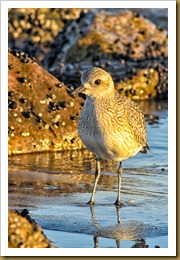
Black-bellied Plover
It was a cool, clear morning today and we set off for Plymouth, Massachusetts to see what there was to photograph.  First stop was at Nelson Beach with the tide was out.  The prominent bird species were gulls.  There were also a half dozen black-bellied plovers running on the beach.  One of the objects I photographed, was seaweed.  Normally when the tide is out you find the seaweed just laying flat on the ground.  Today, however, there was a small tidal pool with green seaweed standing upright and waving in the pool.
Green Seawee d Waving in the Water

We then traveled down to the harbor where except for a rare gull.  Nothing was present, not even the usual large flock of rock pigeons.

Our next stop was Jenney's Pond, where again, the common birds were Canada geese and mallards.  We also found a mallard hybrid.  Looking at this bird.  It is hard to say what was the other species involved in making up the hybrid besides the mallard.  Looking at the picture, the eye is very pale.  I wonder if there was an injury to it.
Hybrid Mallard
Canada Goose Flapping

Mallard Being Chased by a Mallard

Great Blue Heron Sitting at the Edge of the Pond
We finished off the morning at Manomet point, where the only species that were seen were Cormorants and gulls. There were no seals or waterfowl anywhere in sight.

But as I have said before a day out photographing is better than a day in front of the desk. <

Using the coupon code mborn you will receive a 15% discount on any or all of the Topaz plug-ins.


Help Support my blog by purchasing from Amazon. Clicking on this link and utilizing the link does not cost you anything.
BUY FROM AMAZON

Thursday, May 28, 2015

Parker River National Wildlife Refuge

Gadwal in the Pannes
On Tuesday morning, the family and I left early to beat the traffic through Boston on the way to visit Parker River National Wildlife Refuge.  Because of the breeding season for terns and piping plovers all the beach accesses in the refuge, were closed to traffic.  Not until we reached Sandy Point State Reservation were we able to walk out onto the beach.  We very slowly drove up the road from the entrance, stopping and photographing different birds, as we visualize them.  We walked the number of the trails enjoying the sights and the weather.  Mostly what we saw were the breeding birds.  Meeting a number of birders, they all remarked on the lack of migrants compared to a few days ago.  Apparently apparently the migrants continued on their northward journey.
Easton Kingbird

Bobolink

Willet.  On the Top of a Tree


At Sandy Point, we saw a few shorebirds, including black-bellied plover, dunlin, and my first of the year piping plover.  There was an adult great black-backed gull feeding on a crab, the interesting part, the crab was still alive.
Piping Plover Feeding

Black-Bellied Plover

Great black-backed Gull With a Crab

We met a birder at Bill's Forward Blind, who told us about some other locations in the area that we did not know about, since we are mainly southeastern Massachusetts, Rhode Island people.  After leaving Parker River, we end up traveling down Rough Meadows Massachusetts Audubon Sanctuary in Raleigh Massachusetts, which we explored for only a short time.  The reason was it was the middle of the day, there was a bright sun and we were hungry.  Looking at the sign of the sanctuary trails, there were a number of different ones to walk, plus if we go down the road further we end up on the backside of Parker River.

Using the coupon code mborn you will receive a 15% discount on any or all of the Topaz plug-ins.


Help Support my blog by purchasing from Amazon. Clicking on this link and utilizing the link does not cost you anything.
BUY FROM AMAZON

Thursday, April 17, 2014

Comparisons between American Golden Plover and Black-bellied Plover

American Golden Plover summer plumage
Approximately 3 years ago I wrote a blog about the American Golden Plover. I thought for this blog I would demonstrate the differences between the American Golden Plover and the Black-bellied Plover especially when they are not in their breeding plumage and can be easily confused.
Black-bellied Plover winter plumage

American Golden Plover winter plumage


Both plovers breed in the Arctic tundra. The American Golden Plover migrates self over the Atlantic Ocean south to South America. The Black-bellied Plover can be found on six continents during the winter and does pass through Massachusetts.

Usually Black-bellied Plover are found along the shore or in plowed fields while the American Golden Plover is usually found in marshes or in plowed fields.
Black-bellied Plover winter plumage

American Golden Plover transitioning into winter plumage

Black-bellied Plover summer plumage

American Golden Plover summer plumage

Friday, November 4, 2011

A Morning at Gooseberry-Birding and Photography

I have been going out to Gooseberry for a while before sunrise in order to get the different looks that each day may bring as the sun comes up over Buzzards Bay.  This day I picked up my friend and colleague Doug early so I could get there before sunrise and then we will going to spend the morning birding.
The colors in the sky started off with bands of light red into dark blue and then progressed into theuntitled D7K_7968 November 03, 2011 NIKON D7000 reds as the sun finally rose.
untitled Civil Dawn D7K_7971 November 03, 2011 NIKON D7000
The last two photographs were taken with my long lens

untitled pre sunrise D3B_8245 November 03, 2011 NIKON D3S
untitled Sunrise D3B_8249 November 03, 2011 NIKON D3S
I did not get what I consider a full series of pictures of the sunrise, because swimming into view where a pair of horned grebes.  I went to my car to set up my 500 mm lens with the 1.7 tele-converter so that I could photograph them.  Luckily, the Greebes were not skittish and I was able to get down to the waters edge, and being low able to photograph the grebes.
untitled Horned Grebes D3B_8273 November 03, 2011 NIKON D3S
Horned Grebes
After the sun rose, we started out following along the shoreline, observing and trying to photograph the birds that we saw.  On the east shore, where the water was smooth.  There were a few Sanderlings, an American Golden Plover and a few Black-Bellied Plover's.  There was the usual gulls, eider's and cormorants in the water at the tip.  Turning around the corner to come down the west side, the water was rougher with both swells and waves, and there were a lot more birds present, and they were more active.
untitled Black-bellied Plover wavesD7K_8160 November 03, 2011 NIKON D7000
Black-bellied Plover with waves
untitled Black-bellied PloverD7K_8137 November 03, 2011 NIKON D7000
Black-bellied Plover
untitled Sanderling flying of rock with Dunlin on Rock D7K_8269 November 03, 2011 NIKON D7000
Sandrlings flying from rock - There is a Dunlin on rock
untitled Sanderling landingD7K_8068 November 03, 2011 NIKON D7000
Sanderling landing
untitled Sandrling Standoff D7K_8063 November 03, 2011 NIKON D7000
Sanderling Stand Off
untitled DunlinD7K_8282 November 03, 2011 NIKON D7000
Dunlin
A small brown bird flew from over the water and landed just above us on the land.  From the brief glimpse that we had, we were thinking possibly a Horned Lark or a Lapland Longspur.  On walking up to where the bird had landed much to our surprise, a beautiful White-throated Sparrow popped out in front of us.  It had brilliant colors, being that it was the white morph variety.
untitled White-thrated Sparrow - white morph-D7K_8323 November 03, 2011 NIKON D7000
White-throated Sparrow - white morp
In the rough water, feeding and swimming were common loons, a red-throated loon, surf and white wing scooters.  Flying by was a nice flock of American (Black) scooters.
untitled American -Black- ScotersD7K_8232 November 03, 2011 NIKON D7000
American or Black  Scoters

Friday, October 14, 2011

American Golden Plover (Pluvialis dominica)

I am continuing to post about my findings on the Columbus Day weekend.  A rarer bird to locate, although it is not unusual to find it, is the American Golden Plover (Pluvialis dominica). untitled _ROT8019 October 08, 2011 NIKON D3S The most common large plover that we see along the shore and on mowed fields is the Black-bellied Plover (Pluvialis squatarola).(Shown here with a Greater Yellowlegs) untitled Black-belled Plover Greater YellowlegsMSB_9732 August 27, 2011 NIKON D300S


This summer, when I was up in Churchill, Manitoba, I was able to photograph the American Golden Plover in full breeding plumage. untitled D7K_0054 June 20, 2011 NIKON D7000untitled D7K_0064 June 20, 2011 NIKON D7000untitled D7K_9995 June 20, 2011 NIKON D7000 They are spotted gold and black on the crown, back and on their wings.  Their face and neck are black with a white border and they also have a black breast and a dark rump and their legs are black.  They breed in the Arctic tundra from northern Canada and Alaska, nesting on the ground in a dry open area.

They are a migratory bird and winter in southern South America.  It's migratory route is over 25,000 miles, and they fly 2400 miles over open ocean.  In the fall.  They migrate south in an easterly fashion.  When they return knots would they pass through Central America and central United States on their way north.

It is felt that the American Golden Plover and the Eskimo Curlews (which are now extinct) with a shorebirds that attracted the attention of Christopher Columbus in early October 1492.  So I guess it's appropriate that it was on Columbus Day weekend when I found the migratory American Golden plovers on two separate days in two separate locations.  First, I found them on Sachuest Salt Marsh  in Middletown, Rhode Island untitled Ameican Golden Plover_ROT8027 October 08, 2011 NIKON D3Sand the next day on the Fuller Street fields,untitled D7K_5742 October 09, 2011 NIKON D7000 which is part of the Cumberland's IBA in Middleborough, Mass.

The American Golden Plover is similar to two other golden plovers, Eurasian and Pacific.

For all of you who live along the Eastern coast of the United States, keep an eye open for the American Golden Plover as it migrates southward This fall.