Showing posts with label Horseneck beach state reservation. Show all posts

Sunday, August 2, 2015

Shorebirds and Lepidoptera

Sandeling
Although I still have a number of pictures from the Downeast Maine trip to review and process, I went out yesterday morning and visited Horseneck Beach State Reservation, and then went to Allens Pond.

The surf at Horseneck was rough.  In fact, there were two people surfing.
Surfer

Surfer
The tide was incoming and there was a number of shorebirds running around.  We picked a portion of the beach that was not inundated with water ye to sit down to photograph the shorebirds running back and forth.  The only problem came as people decided to walk in the edge of the water along the beach, which cause the shorebirds to fly.
Great Black-backed Gull

Semipalmated Sandpiper

Semipalmated Plover
Sanderling

At least the shorebirds flew back and walked right by us..  As more people were arriving at the beach.  The birds were flying away to unoccupied areas.  Packing up, we drove to Allen Pond and prior to the beach ramble, we photographed around the butterfly garden.  I saw my first Monarch of the year and finally was able to obtain photos of a Clearwing Hummingbird Moth.
Monarch Butterfly

Clearwing Hummingbird Moth


Using the coupon code mborn you will receive a 15% discount on any or all of the Topaz plug-ins.


Help Support my blog by purchasing from Amazon. Clicking on this link and utilizing the link does not cost you anything.
BUY FROM AMAZON

Friday, July 17, 2015

Visit to the Least Terns Again

Least Tern and Chick
Visiting the least tern colony at Horseneck Beach State Reservation in Westport, Massachusetts again to see what has changed.  There was less terns in the colony, however, what was interesting is that there was still a nest with eggs, small chicks and fledgling least terns.  In fact, there were terns spread all over the beach.  We had a great time photographing the activities of the little terns.

Least Tern and Chick
Least Tern Family
Fledged Least Tern
Fledged Least Tern Being Fed by Adult
Fledged Least Tern
Least Tern Chick Calling for Food
Least Tern Going to Sit Back on Her Eggs on the Nest
Least Tern, Sitting on Eggs on Nest

Remember, if you visit a colony of protected birds, stay behind the fence line and do not harass them.  Also, try to shoot them on their level which will give you the better picture.  Since shorebird migration has already started visits to the shore on an incoming or outgoing tide may give you a chance to see and photograph many different species.

Using the coupon code mborn you will receive a 15% discount on any or all of the Topaz plug-ins.


Help Support my blog by purchasing from Amazon. Clicking on this link and utilizing the link does not cost you anything.
BUY FROM AMAZON

Monday, July 6, 2015

Least Terns

Least Tern And Chick
Friday, July 3 was a beautiful sunny day and we went out to Horseneck beach state reservation early in the morning, so we we get there before the rush of beach-going traffic.  When we arrived, there were a few cars in the parking lot and our plans were to photograph the least tern colonies that are on the beach.  There are a number of areas roped off to protect these endangered birds, along with piping plovers, all of who nest on this beautiful beach.  Even with the areas that were roped off, there was still a large portion of beach available for the sunbathers.  Walking near the roped off areas, the least terns would fly and bombard us to protect their young, and their nests.  After a while the terns went on with their normal behavior of flying out to see and bringing in fish to feed the young.  There were a number of young least terns running all over the place and waiting for a parent to bring them food.  What was interesting is that there.  Juveniles and adults, new who belongs to who.  In fact, if an adult landed near a check that was not theirs they would be chased away by an adult whose check it was.  Depending on the colony the ages of the chip were different, and in fact the older checks are roaming all over the beach, so that beachgoers have to be careful where they step.  I met up with Jamie Bogart from the Lloyd Center in Dartmouth, who monitors the plovers and terns at Horseneck.  He told me that this year has been a good year for production of young.

Least Tern in Flight Carrying a Fish
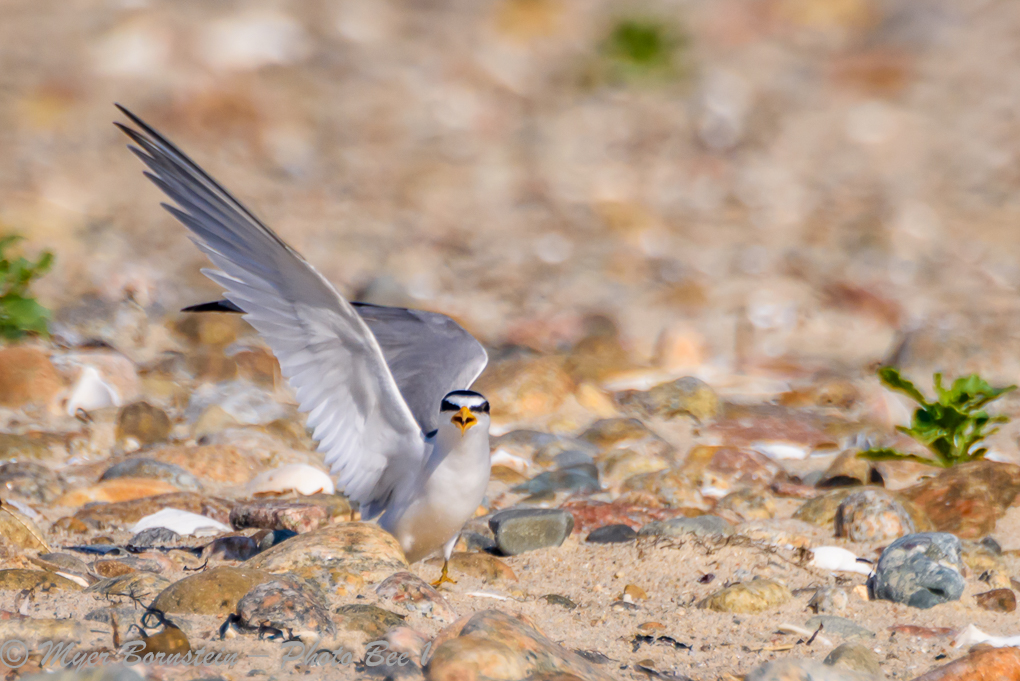
Least Tern on Ground with Wings Raised
Least Tern in Flight Overhead
Least tern adult feeding a chick
Least Tern, Chick in the Shade
Least Tern Adult Carrying a Fish Looking for Its Chick
Older Chick Running in the Sand
We need to thank the Commonwealth of Massachusetts, all the organizations who monitor these sites and all of volunteers and interns that help protect our endangered shorebirds, and terns.

Using the coupon code mborn you will receive a 15% discount on any or all of the Topaz plug-ins.


Help Support my blog by purchasing from Amazon. Clicking on this link and utilizing the link does not cost you anything.
BUY FROM AMAZON

Friday, December 20, 2013

Feeding Frenzy

Add caption
During my visit to Gooseberry the other day, I spent time watching it photographing the groups of Gulls and Peeps feeding in the water and on the wrack line. The gulls were catching slipper shells from the water, bring them in on land and trying to eat the gastropod that is inside the shell. The peeps, mainly Dunlins would check out the slipper shells and eat what was left inside. I do believe the recent storm had turned up the bottom and brought the slipper shells close to shore.

Dunlin carrying a slipper shell

Herring gull with slipper shell

Dunlin feeding on slipper shell

Dunlin feeding on slipper shell

Dunlin feeding on slipper shell

Dunlin feeding on slipper shell with a ring-billed gull in the background

Dunlin feeding

Herring gull feeding on slipper shell

Herring gull dropping a slipper shell
The common slipper shell, Crepidula fornicata, is a species of medium-sized sea snail, a marine gastropod mollusc in the family Calyptraeidae, the slipper snails and cup and saucer snails. They are often found, sometimes living stacked on top of one another, rocks, on horseshoe crabs, shells and on dock pilings. What is interesting about the slipper shells especially the stacked ones is that the largest and oldest animal at the base of the pile is a female and the younger and smaller animals are the males. If the female for some reason dies, the largest male becomes the female. For this reason that is why they are known as a sequential hermaphrodite.
Slipper shell looking underneath showing the shelf that gave this shell its name

Top view of slipper shell

Pair of slipper shells

Wednesday, December 18, 2013

Look Up and Down

This morning I went out to gooseberry arriving about a half hour before sunrise and as I approached the end of the causeway a snowy owl flew off the sign. And as I slowly drove up to the parking area, again the snowy owl took off from where it was sitting on a mound. It flew up to the east side of the island. I waited till it got lighter and then was slowly walking up on the beach when I saw a gentleman that I knew who runs with his Huskies there every morning. The Huskies are on a leash. I took some pictures of him and his Huskies
and then  off to my right behind him a snowy owl popped up and went down again. The gentleman I talked for a while and then he left to take the dogs home and I slowly walked toward where I had seen the snowy owl. However, as hard as I looked no signs of the snowy owl. Looking toward the West, the moon was a little bit visible through the clouds and I noticed a northern Harrier flying toward me and the light wasn't good but I did take some pictures.
Coming home and looking at the pictures, what to my surprise, the Harrier made one attack pass at a snowy owl in the tree. I was too busy taken pictures of the area that I missed the snowy owl. Oh well, will try again another day.This shows you that you have to keep your eyes open to what is happening around you.

Sunday, March 3, 2013

Comet Pan-STARRS

Come join me, a great event is going to occur in March.  The comet Panstarrs should be be visible in the Western sky, after sunset.  I am planning on being at Horseneck Beach State Reservation in Westport, Massachusetts, on the beach below the bathhouse, by parking lot one, starting at 6:15 PM on March 12 through the 14th.  Sunset is around 6:45 PM and we will be watching and photographing the event.  People should dress appropriately, bring binoculars and if they want to try to photograph the event both a wide-angle and short telephoto lens along with a tripod and camera release, if available.  Also helpful will be hand warmers to wrap around the lens to prevent fogging.  Fully charged batteries for the camera and cards to record the event.

Hope to see you there.

Here is more information on the comet.
From Space Weather News
"Comet Pan-STARRS (C/2011 L4) is now inside the orbit of Mercury, brightening as it plunges toward the sun. Observers in the southern hemisphere report say they can see Pan-STARRS with the unaided eye in the evening sunset sky.
"Despite bad light and smog pollution, the comet's nucleus was clearly visible to the naked eye as well as a small part of the tail," says Gruber. Light curves show the comet is approaching 2nd magnitude, about as bright as the stars of the Big Dipper.

Several important dates are approaching. On March 5th, Comet Pan-STARRS makes its closest approach to Earth (1.09 AU), followed on March 10th by its closest approach to the sun (0.3 AU). As Comet Pan-STARRS passes the sun, solar glare will make it difficult to see even as the nucleus vaporizes and brightens. By March 12th and 13th, the comet will reappear in the sunset skies of the northern hemisphere not far from the crescent Moon; think photo-op!

Throughout March 2013, the comet should be visible in the Northern Hemisphere evening sky low in the west after sunset. It will move northward each evening during March 2013 as it moves from being in front of the constellation Pisces to being in front of the constellations Pegasus and Andromeda. At this time, the comet might have a bright dust tail, and  should be visible to the unaided eye or binoculars.