Showing posts with label Least Terns. Show all posts

Monday, July 6, 2015

Least Terns

Least Tern And Chick
Friday, July 3 was a beautiful sunny day and we went out to Horseneck beach state reservation early in the morning, so we we get there before the rush of beach-going traffic.  When we arrived, there were a few cars in the parking lot and our plans were to photograph the least tern colonies that are on the beach.  There are a number of areas roped off to protect these endangered birds, along with piping plovers, all of who nest on this beautiful beach.  Even with the areas that were roped off, there was still a large portion of beach available for the sunbathers.  Walking near the roped off areas, the least terns would fly and bombard us to protect their young, and their nests.  After a while the terns went on with their normal behavior of flying out to see and bringing in fish to feed the young.  There were a number of young least terns running all over the place and waiting for a parent to bring them food.  What was interesting is that there.  Juveniles and adults, new who belongs to who.  In fact, if an adult landed near a check that was not theirs they would be chased away by an adult whose check it was.  Depending on the colony the ages of the chip were different, and in fact the older checks are roaming all over the beach, so that beachgoers have to be careful where they step.  I met up with Jamie Bogart from the Lloyd Center in Dartmouth, who monitors the plovers and terns at Horseneck.  He told me that this year has been a good year for production of young.

Least Tern in Flight Carrying a Fish
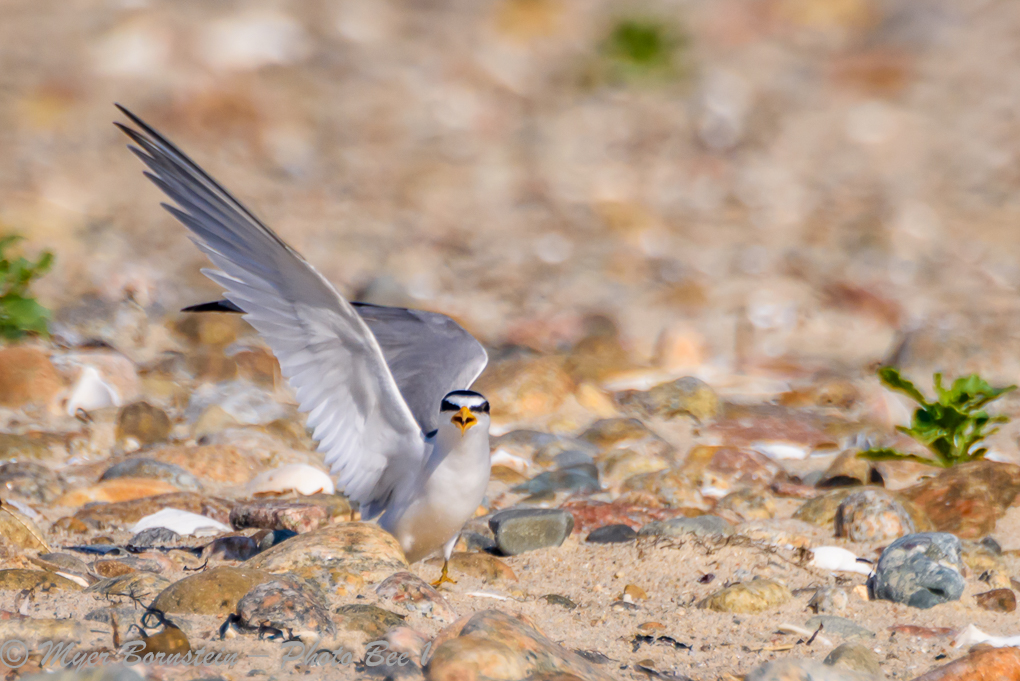
Least Tern on Ground with Wings Raised
Least Tern in Flight Overhead
Least tern adult feeding a chick
Least Tern, Chick in the Shade
Least Tern Adult Carrying a Fish Looking for Its Chick
Older Chick Running in the Sand
We need to thank the Commonwealth of Massachusetts, all the organizations who monitor these sites and all of volunteers and interns that help protect our endangered shorebirds, and terns.

Using the coupon code mborn you will receive a 15% discount on any or all of the Topaz plug-ins.


Help Support my blog by purchasing from Amazon. Clicking on this link and utilizing the link does not cost you anything.
BUY FROM AMAZON

Thursday, May 29, 2014

Barney's Joy and a "Sunrise Shorebird Shoot (with your camera!)"

Today I returned to Allens Pond joining Josie and one of the wildlife interns Kourtney for a visit to Barney's Joy.  The private beach at Barney's Joy is one of the sites that are monitored by the shorebird monitoring program.  Least terns are the the main endangered bird that is encountered out at Barney's Joy.  Just before we went to Barney's Joy, we went down to the beach loop at Allens Pond where Josie showed Kourtney the new piping plover nest that we found yesterday.
Josie and Kourtney

area of the nest

Compared to yesterday, the weather was overcast and there was intermittent slight drizzle, plus the winds were blowing out of the north northwest.  The temperature with the wind chill was probably in the 40s.

The majority of the least terns were huddled in the leeward side, but at times the terns were being blasted by the wind blown sand.  This gave the appearance of rain/snow.
Least Terns

Least tern being blasted by the wind-blown sand

Besides the least terns, a willet and oystercatcher flew by and there was one piping plover running around foraging.  The piping plover probably came from the nest that is located on the opposite side of the channel.
Piping Plover
 To celebrate the beginning of the summer, join me for a "Sunrise Shorebird Shoot (with your camera!)"  Sponsored by Allens Pond, Sat, Jun 21, 2014 5:30 am - 12:00 pm.  We will meet at the field station, and then travel out to Gooseberry to begin photographing.  Recommended, a long lens of at least 300 mm plus a tele-converter and a tripod.  Be prepared to get wet and dirty, because the best pictures are obtained by shooting at the level of the shorebirds.  I recommend knee-pads to protect your knees from the rocks.  I would bring non-DEET bug spray and sunscreen along with water and a snack.  After we finished at Gooseberry, we will returned to Allens Pond and photograph on the beach loop.  We will finish up with lunch and a review of the morning activities. You can sign up at http://www.massaudubon.org/get-outdoors/program-catalog#program:sanctuary=25:program_code=34448
Cost is $20 for members and $24 for non-members

Wednesday, May 28, 2014

Coastal Waterbird Monitoring

Piping Plover
Allens Pond Massachusetts Audubon Sanctuary is a participant in the Coastal Waterbird Program. The Coastal Waterbird Program monitors and protects more nesting sites on the Atlantic coast than any other non-governmental entity. Every year from March through September, we utilize a variety of management techniques to protect nesting and migratory coastal birds from human disturbance and predators.
Examples of management techniques include:
·    symbolic fencing
·    signage
·    electric fencing
·    exclosures
The Coastal Waterbird Program protects over 60 miles of coastline annually and manages approximately:
·    40-50 percent of the state's piping plovers
·    40 percent of Massachusetts least terns
·    20 percent of Massachusetts American oystercatchers
The program focuses on protection of the most threatened species of coastal birds, and more broadly, coastal ecosystem management. The Coastal Waterbird Program serves as a model for integrated coastal resource management.
Allens Pond has two monitors, Allison and Josie, who monitor and survey certain areas, keeping track of the endangered species, piping plovers, least terns, common terns, plus American oystercatchers.  They also monitor predators by utilizing trail cameras and at times being out all night monitoring.

I traveled with Josie as she surveyed the beach loop and East beach areas.  We did locate some new nests along where the oystercatcher was nesting.
Piping Plover

Piping Plover on Nest

Piping Plover

Piping Plover looking for a bug
American Oystercatcher

American Oystercatcher on nest
We spent some time observing the least terns, some more nesting and being fed by the male and others with a male was trying to find a mate by offering a fish.
Least Tern, offering a fish

Least Tern, offering a fish

Because the female least tern was on nest.  The male least tern left with its fish, looking for a mate

Least Tern, offering a fish

There was a group of approximately 10 Dunlin in breeding plumage in the East beach area
Dunlin, hopping on 1 foot, they keep the other foot up in the body to reduce heat loss
We made sure if a bird was on a nest, and when we were near it, it got off the nest, we would immediately leave.


Remember Topaz Clean is a great value: it's originally $29.99 but the price is dropped to just $14.99 for this promotion.  This promotion ends on May 31 and utilizes the coupon code

"mayclean". http://www.topazlabs.com/aff/idevaffiliate.php?id=850&url=http://www.topazlabs.com/clean