Showing posts with label Killdeer. Show all posts

Sunday, July 5, 2015

Killdeer on Her Nest

Killdeer on Her Nest
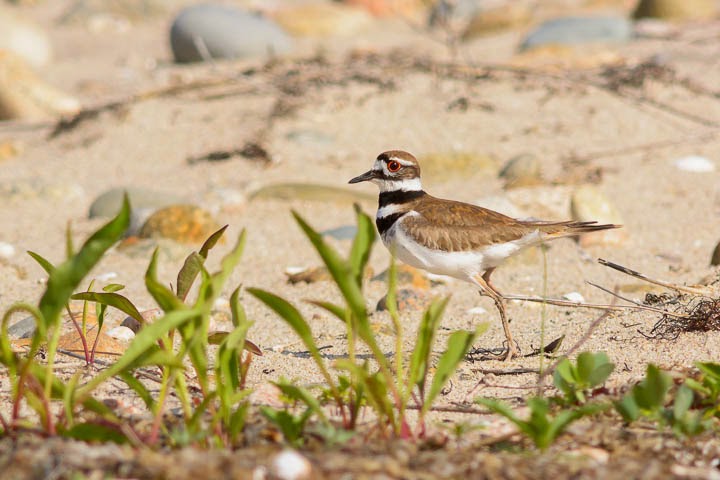
In a recent blog, I had discussed the broken-wing display of the killdeer.  I just decided to go back to observe and photograph the Killdeer on her nest.  Of course, when I approached the Killdeer went into broken wing display.  I chose a spot close by and lay down on the sand.  My lens and camera was supported on a gimbal head attached to the skimmer pod.  By being essentially as still as I could, the Killdeer came back to her nest and I observed her as she moved around and looked around her surroundings.  The Killdeer apparently got used to me and the only time she moved away from the nest, was one people walked by on the beach.  Using this methodology gave me a chance to watch the natural behavior of a Killdeer.  The Killdeer would look around, keep an eye on her surroundings, occasionally stand and change position.

Me
Killdeer on Her Nest


Using the coupon code mborn you will receive a 15% discount on any or all of the Topaz plug-ins.


Help Support my blog by purchasing from Amazon. Clicking on this link and utilizing the link does not cost you anything.
BUY FROM AMAZON

Wednesday, July 1, 2015

Distraction Display

Killdeer showing Broken-Wing Display
After photographing the piping plovers yesterday, we noticed further down the beach a Killdeer.  We walked down to the area to photograph the killdeer.  As we approached the Killdeer started performing the broken wing display.  This was to drawer us away from wherever the killdeer had a nest.  After photographing the killdeer performing and we walked away.  The Killdeer went back to the same area where we originally saw the killdeer and when we walked back to get further down the beach, the killdeer again for from the broken-wing display.  Pass in the area where we had first noticed the Killdeer.  We look closely, but could not find the nest.

Killdeer showing Broken-Wing Display
Many animals use distraction displays to entice predators away from their nest or young.

This information is from Wikipedia
“Distraction displays, also known as deflection display, diversionary display or paratrepsis, are anti-predator behaviors used to attract the attention of an enemy away from an object, typically the nest or young, that is being protected. They are particularly well known in birds but noted also in fish. Distraction displays are, however, not very well defined and the definition has been the subject of much debate. They are sometimes classed more generically under "nest protection behaviors" along with aggressive displays such as mobbing.
It has been suggested that distraction displays exist mainly in birds, since they have the ability to escape at the last moment out of reach of ground predators. Displays are used mainly for ground predators, and are rarely used against avian predators
Several variations are known in these distraction displays. Nesting male three-spined sticklebacks, when approached by groups of conspecifics, will move away from the nest and simulate feeding on the substrate. Adults will feed on the eggs of nesting conspecifics.
 False brooding is an approach used by plovers. The bird moves away from the nest site and crouches on the ground so as to appear to be sitting at a nest and allows the predator to approach close before escaping.
Injury feigning is one of the more common forms of distraction. The broken-wing display is particularly well known in nesting waders and plovers and doves such as the mourning dove. Birds that are at the nest walk away from the nest with one wing hung low and dragging on the ground so as to appear as an easy target for a predator. Several interpretations have been made for the evolution of the behavior and the cognitive abilities involved. Another display is the rodent run, which is seen in plovers as well as some passerine birds Here the nesting bird drops to the ground or moves away, creeping along with the head held low and making turns as if dodging imaginary obstacles.
These birds will frequently use a distraction display ("broken-wing act") to distract predators from their nests. This involves the bird walking away from its nesting area holding its wing in a position that simulates an injury and then flapping around on the ground emitting a distress call. The predators then think they have easy prey and are attracted to this seemingly injured bird and away from the nest. If the parent sees that a potential predator is not following them, they will move closer and get louder until they get the attention of the predator. This is repeated until the predator is far from the nest, and the killdeer suddenly "heals" and flies away.”

Friday, June 5, 2015

Plovers, Set, and Nature Photography Day

Killdeer
Yesterday afternoon we returned to Nelsons park in the beach to see if we could find anything new.  In the grass failed, by the parking lot, a pair of killdeers were voicing their displeasure at us as we were in the area.  In fact, one of the killdeers flew to the wall and did not give a broken wing display acted like she was injured, which made me think that they either had a nest, or young ones in the area.  I believe they have young ones somewhere around because both killdeers were up and moving.
Killdeer in Injured Pose

Killdeer Vocalizing

The tide was low and the mud flats at the beach had a number of semipalmated plovers running up and down and feeding.  I was able to photograph one plover eating a large sand worm.
Semipalmated Plover Eating a Sand Worm

Semipalmated Plover Eating a Sand Worm

Semipalmated Plover Eating a Sand Worm

Semipalmated Plover Eating a Sand Worm

In the water, between Nelson and Long Beach.  There was a feeding frenzy going on with gulls, terns and a great blue Heron.

As it was getting closer to sunset, we traveled up to Manomet Point to photograph the sunset over Whitehorse Beach and Plymouth.  There were low clouds in the sky, and as the sunset, the clouds in the sky were lit up with color, which continue to at least 15 minutes after sunset.  They were reds, yellows and oranges.  For these pictures,  I used my Nikon D810, Nikon 80 to 400, all on a tripod,ISO 125 in manual mode and utilize live view.  I set the camera for a two second delay in shutter release to stop vibrations in the mirror and used a remote release.  I also took some sets of bracketed pictures which I processed in LightRoom utilizing their new HDR interface.
Sunset at Manomet Point

After Sunset at Manomet Point

After Sunset at Manomet Point


June 15:  Nature Photography Day Celebrates 10 Years
A camera, time, and your imagination can be the best ways to celebrate Year 10 of Nature Photography Day.! Nature Photography Day is a time to appreciate how images influence our world.

Looking for ways to enjoy the day?  Take yourself on a photo adventure. Teachers and students: Explore a setting you haven’t yet photographed, and arrange to shoot on June 15. Show children how to photograph flowers or trees in their backyard or other places close to home. Inspiration and beauty can be close by.  
For those people who are interested, I will be at Allens Pond, Dartmouth Massachusetts at 8 AM on June 15, come rain or shine to photograph the beauty that surrounds us.  Everybody is welcome

Plus, NANPA is hosting two separate events on Facebook.

1. The Nature Photography Day Member Event is back, and so is our page on Facebook! Take images on June 15, and upload one for the event section.  

2. New this year on NANPA’s Facebook Group Page:  a special photo contest sponsored by Tamron, Red River Paper, Hunt’s and NANPA.
For details, visit www.nanpa.org/nature_photography_day.php.

On June 15, see where your photography takes you!

Sunday, July 6, 2014

Interaction between Killdeer and Piping Plover

Piping Plover

Killdeer
Prior to my opening of my photography show on July 5, I joined my friend Doug.  As he led a beach ramble in the morning at Allens Pond.  It was a beautiful clear comfortable day with a breeze blowing.  We had interested people that came with us and learned about the area and nature.

The fun for me that morning was observing and photographing the interactions between a family of piping plovers and killdeer.  I am not sure if the killdeers were protecting a nest or young from the piping plovers, however, the piping plovers were protecting their chicks.  The piping plovers were further down the breach and were returning up toward where there nesting area was when they passed by the killdeer.  The piping plovers flew at and around the killdeer, then landed and started and injured wing display drawing the killdeer to the adult piping plover and away from the piping plover chicks as they made their way back up the beach.  This event continued on until the piping plover chicks were safely away from the killdeer.

Interaction between Piping Plover and Killdeer

Interaction between Piping Plover and Killdeer

Interaction between Piping Plover and Killdeer

Interaction between Piping Plover and Killdeer

Interaction between Piping Plover and Killdeer

Interaction between Piping Plover and Killdeer

Interaction between Piping Plover and Killdeer

Earlier in the season, when the killdeer chicks were roaming near where the piping plovers were nesting the killdeers attack the piping plovers until the killdeer felt that there chicks were safe.

As I have noted before on a blog adult birds try to protect their young from what they consider predators.


I created this limited edition print  8.5 "x 11 " to honor the first year that I was able to photograph the entire family.  Half of the proceeds will be a donation to Allens Pond Massachusetts Audubon Wildlife Sanctuary to help them continue public service. When you order please include your name and mailing address, Thank You.


Limited Edition of 25
numbered and signed

Friday, May 23, 2014

Piping Plovers and Harassment

Piping plover on the beach
When you read the title, I bet the first thing you thought was that the piping plovers were being harassed by people or dogs.  Well, you were wrong.

Today I visited Allens Pond, first, to set up some programs for the upcoming summer and to go down and see if my piping plovers were nesting again.  Yes, for the fifth year in a row, the piping plovers on nesting near the walkway to the beginning of the beach loop.

When I arrived the first thing I noticed were Killdeer running around behind the roped off area and when I took a good look, there were two adults and four chicks.  As I watch and photograph them, out of the corner of my eye, I noticed a white object moving.  It turned out to be a piping plover.

Killdeer, looking for its chicks and also the piping plovers

Killdeer chick

Killdeer chick parading down the beach
In fact, there were a pair of them.  Now as the killdeer started moving down the beach toward where the piping plovers were, once the killdeer noticed the plover it began to chase them.  One of the plovers try to make the killdeer follow him, while the other plover went back to try to sit on the nest.  The harassment continued until the Killdeer went further down the beach and finally the plover was able to sit on its nest.  From the distance, I saw at least one egg in the nest.  After reviewing the photos there are 3 eggs present in the nest.  I also found out this is the second episode of egg laying . These plovers lost their first set of eggs.  Hopefully, the killdeer will move out and the piping plovers can nest in peace.
Piping plover looking out for a Killdeer

Piping plover nest with three eggs

Piping plover coming back to sit on the eggs

Piping plover sitting on the eggs


Using the coupon code mborn you will receive a 15% discount on any or all of the Topaz plug-ins.


Help Support my blog by purchasing from Amazon
BUY FROM AMAZON
Click here to visit Ian Plant Photography.