Showing posts with label spiders. Show all posts

Tuesday, June 2, 2015

Macro Photography in Lakeville

Variable Dancer
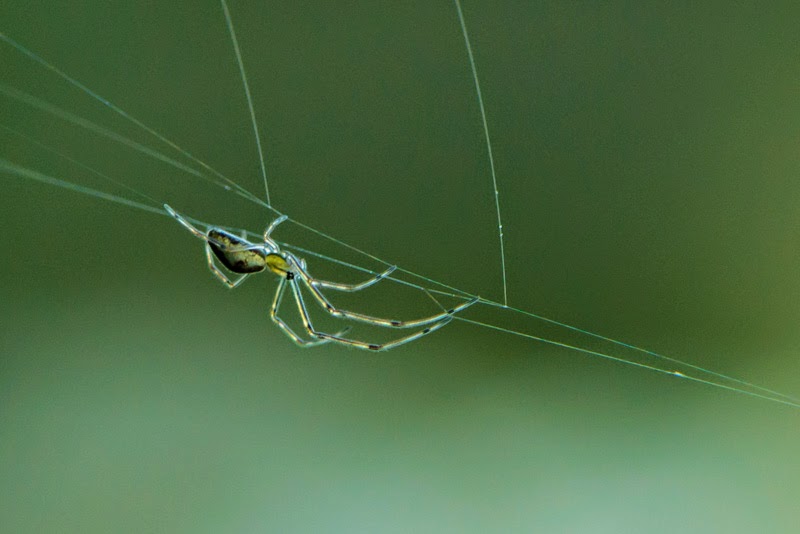
It is that time a year again.  The weather is warming, insects are hatching, flowers are blooming and it is time to do macro photography.  The other day, I travel to two of my favorite spots in Lakeville to do some macro photography.  Normally, I utilize a tripod when I am doing macro photography.  That has a problem in that you have to be careful way you move the tripod, because, if you hit a leaf or anything it will scare the insect.  This day I decided to handhold my Nikon D810 and my Nikon 105 macro lens and see what I would come up with.  I found I had to increase my ISO and shutter speed and shot a burst series.  I had a good time photographing damselflies, dragonflies and spiders.  On reviewing the pictures on the computer after downloading I found a good number that were not in focus due to my movements.  Oh well, those got deleted but still left me a number of sharp images.
Spider

Spider Weaving Its Web

Slaty Skimmer

Slender Spreadwing


Dragonfly Nymph Exoskeleton

On the side of Poska Pond, I found a number of very pale looking damselflies.  I thought these may be newly hatched damselflies and this was confirmed.  They are known as 'teneral' which is  the state of an insect immediately after molting. At this time the insect's exoskeleton has not hardened and it may be pale in color.
Damselfly after Nymph Stage It Is a Teneral

The following picture was taken with the same camera/lens combination, but it is not a macro.
Marsh with a Wood Duck and a Red-Winged Blackbird Flying Overhead
So as we approaching summer do not forget the little things that surround us also and enjoy photographing them.  Vistas are great, but you can do macro photography right around your own home.


Using the coupon code mborn you will receive a 15% discount on any or all of the Topaz plug-ins.


Help Support my blog by purchasing from Amazon. Clicking on this link and utilizing the link does not cost you anything.
BUY FROM AMAZON

By the way, I know some of you have bought Collier's guide to photographing the night sky and there are a number of people who learn better by viewing a video.  I like having a video, since I have two computer screens I keep the video on one and use the other to follow along working on a picture.  Collier has produced the video on all the steps in post processing a night sky photograph.http://www.payloadz.com/go/jump?id=2890652&aff_id=3522556

Thursday, November 27, 2014

The Recent Trip to Costa Rica, part one

Statue in the gardens
I just returned from an excellent trip to Costa Rica, led by Greg Basco.  The tour was entitled the Art of Biodiversity-Pacific.  We had a wonderful group of people, besides myself, Moira from Scotland, Jim and Hali from Rhode Island, Allison from England and Sean from Wisconsin
Orchids

orchids
crocodile statue surrounded by plans
flowers
spider
sunset from my balcony
The first evening of the trip, we all gathered in the bar for a drink and introductions, and then we went into the dining room of the Hotel Bougainvillea for supper.  What makes the hotel so great that it is surrounded by a beautiful tropical garden that is enjoyable not only just to look at, but to photograph.
Looking at the garden from my balcony
morning rainbow
The next morning after breakfast, Greg gave us a presentation and told us how to use fill flash both on and off the camera to create more pleasing pictures and then we went to photographed macro subjects in the garden of the hotel.
Land snail on a bromeliad
orb weaving spider
looking for my room out past the balcony
entrance to the hotel
more of the garden
Later in the morning, our tour bus arrived, driven by José, who is not only the driver but an excellent photographer also, and is a major asset to Greg's team.  After loading the bus, we drove to our next location, Cerro Lodge, which would be home for the next three days.  After settling in, we set up our equipment and started photographing birds that were coming to the feeders.  Some of the birds were cinnamon hummingbird, clay-colored thrush, and the melodious blackbird.

cinnamon hummingbird
White-throated Magpie-Jay
Rufus-napped Wren and coconut palm flowers
After a delicious supper, José heard the black and white owl calling and was able to located in the trees near the parking lot.  Everybody went and got their equipment and we were able to photograph this beautiful bird.
Black and white owl
Stay tuned for more follow-ups on the adventures in Costa Rica.

From November 28th through December 1st, Topaz is offering the Topaz Photography Collection (all 15 products) for only $249.99. Whether you want to achieve stunning photo enhancements or apply artistic effects, this unique collection has you covered.  Utilize the coupon code 'BLACKFRIDAY2014' and the URL http://www.topazlabs.com/aff/idevaffiliate.php?id=850&url=http://www.topazlabs.com/store

Think Tank has a couple of special offers for Black Friday for my followers.

1.       Save 25% on our CityWalker messenger bags –  The URL to point to is:  http://www.thinktankphoto.com/categories/shoulder-camera-bags/citywalker.aspx?code=WS-542
2.       Whenever you  order one of our rolling camera bags you will receive our “Road Warriors Kit,” a $44.98 value, for free.   Here is the URL:  http://www.thinktankphoto.com/categories/rolling-camera-bags/airport-series.aspx?=WS-542

Saturday, August 30, 2014

Wee Little Critters

Spider
Since it's part of the summer when spiderwebs are getting more frequent to see, my journey today, took me to a number of places to see what I could find in the way of spiderwebs and spiders.  Again, there were numerous areas of fog and when I arrived at the first location, there was some dew on the plants, but not any on the spiderwebs.  Most of the spiders that I photographed where a quarter of an inch or less in size and even with a 1:1 macro lens, I still needed to crop the pictures.  It still was a great morning photographing these interesting arachnoid and watching the habit of some of the spiders.  One in particular crawl to the edge of is web, and hid underneath the seed head of the plant where the web was attached.

Spider hidden beneath a seed head

Spider on its web

Spider was on its web but with water behind it.  I was able to capture it isolated from everything

This is definitely a wee one


Using the coupon code mborn you will receive a 15% discount on any or all of the Topaz plug-ins.


Help Support my blog by purchasing from Amazon. Clicking on this link and utilizing the link does not cost you anything.
BUY FROM AMAZON

Saturday, July 27, 2013

Funnel Weaver Spiders

Funnel Weaver Spider
As I have previously said, if you search around your house, you always can find something to photograph.  In the arborvitaes around our complex, funnel weaver spiders have created their webs and are waiting for their prey.  Funnel weaver spiders closely resemble wolf spiders, but can be distinguished from them since wolf spiders do not build webs.  As opposed to some of the other spiders, the web of a funnel weaving spider is not sticky and the spider uses its speed to capture its prey.  Also, funnel weaving spiders will retreat into the funnel of the web, and hide when threatened by a larger creature.

Two years ago, it took over one half-hour for me to capture the photograph of a funnel weaving spider that was awarded an honorable mention in the Massachusetts Audubon photo contest.
Funnel Weaver Spider


With the recent rains that we have had, the web, and spiders are covered with water droplets and are interesting subjects.  In the early morning, if you approach them, they are not as nervous and usually will stay in view, allowing photographs.  I have been utilizing my Tamron 180 mm macro lens to capture these images.  Because the spider is usually in the backside of the funnel and in the dark, I have used a handheld LED light or a Nikon macro light set up to illuminate the spider.
Funnel Weaver Spider with raindrops

Funnel Weaver Spider in the back of the funnel

Raindrops on the web


Funnel weaver spiders are medium-size ranging from 8-12 mm long and are usually brown and gray in color with banded legs and spots on the back.  They have eight eyes and two rows of four.  They have to body segments and eight legs.  Funnel weaver is belong to the family Agelenidae and there are 118 species and 12 genera in North America.