Showing posts with label Dragonfly. Show all posts

Tuesday, August 12, 2014

Widow Skimmer (Libellula luctuosa)

Widow Skimmer (Libellula luctuosa)
This morning, rising after a complete nights sleep, I decided to go and do some macro photography.  I found a beautiful widow skimmer, which allowed me to photograph it over a period of time.  Unlike most of the other dragonflies and damselflies that I saw, who were very skittish and really did not want to have their picture taken, the widow skimmer (Libellula luctuosa) was a perfect model.  Even when it flew away.,  It came back to either the same perch or one very close to it.  The widow skimmer was very cooperative and that it gave me a number of different views, straight on head view, side views and top views.
Widow Skimmer (Libellula luctuosa)
 The widow skimmer is found in much of the United States extending into southwestern and southeastern Canada and down into Mexico.  It is common throughout most of Massachusetts, but, red absent on Cape Cod and the islands.  It's flight time is from late May into early September.  Why does the widow skimmer have this name?  The reason is because, unlike other dragonflies, the male leaves the female, after she lays her eggs.

The male widow skimmer is easy to identify, because both the fore and hind wings are black-brown extending from the body to approximately halfway to the tip, plus the males also have a white patchi n the middle of each wing.  The female widow skimmer wings are like the male, but do not have the white patches.

The widow skimmer's of found flying usually over still bodies of water and will rest on vegetation during the day.  What makes widow skimmer's so useful is that they feed on biting flies, mosquitoes, midges and other small flying insects.


I have previously mentioned about the e-books the Ian Plant has on his site that are available either for free or off for a fee.  Right now to celebrate the new storefront opening, he is offering 15% OFF until the end of August on all purchases made in the new store. Please use discount code NEWSTORE at checkout throughout the month to take advantage of this valuable limited offer.  (Note: the discount code is entered at the very end of the checkout process.)  https://ianplantdreamscapes.refersion.com/c/b2bf
 

Wednesday, September 4, 2013

The Spider and the Damselfly Plus More on the TurnStyle Sling Bag

Orb Weaving Spider
I spent a portion of last two days to an macro photography at Tamarac Park in Lakeville.  To carry my gear, I utilized Think Tank Photo's TurnStyle 20 sling bag.  At the end of this blog, I'll show you what equipment I brought with me.

What I find interesting about macro photography is finding new creatures and also observing the interactions between different species.

The series of photos that I am going to show reminds me of the poem by Mary Howitt, "the Spider and the Fly: a Fable" even though this is an interaction between a spider in a damselfly.  On a web in a corner a damselfly was caught and as it moved around the little spider came down, probably thank into itself a meal.  But soon as the spider came next to the damselfly, and the damselfly moved and scared the spider, who ran back up to the center of its net.  I suppose once the damselfly stops moving the spider will come back down and feed on it.
Spider thinking about the damselfly
Spider on the way back to the center of the web


Spider on the way back to the center of the web


In my TurnStyle 20 Sling Bag
http://www.thinktankphoto.com/categories/sling-camera-bags/turnstyle.aspx?code=WS-542, I carried my Nikon D800 with a Tamron 180 mm macro lens attached, a set of extension tubes, Nikon C1 wireless close-up Speedlight system, filters, extra cards, batteries, remote release cable, lens cloths and a scissors.  In the compartment where you can place a tablet, I utilize that to carry my small reflectors.  The only other thing that I have to carry is my tripod.  The TurnStyle bag gives me freedom of movement, without the need for a photo vest.
Some of my Macro Equipment
Rear compartment configured for  camera with lens attached, extension tubes and filters
Rear compartment with wireless ring flash added, front compartment with everything else
Tablet compartment with reflector
TurnStyle Sling Bag ready to go

Wednesday, July 3, 2013

Dragonflies and Damselflies, Two Additional Species

Saffron-winged Meadowhawk
Since I wrote my last blog, I have discovered and photographed two additional species of Dragon, and damselflies.  The first was a Saffron-winged Meadowhawk, either a female or immature male.  I possibly saw a male Saffron-winged Meadowhawk flitting by, but it did not land and I did not get a picture.  The second was a spreadwing damselfly, the Slender Spread Wing, and I was able to get photographs of both a male and female of the species.  What makes spread wings different than other damselflies is.  They perch with their wings partially open.

Saffron-winged Meadowhawk

Saffron-winged Meadowhawk

Slender Spreadwing - Female
Slender Spreadwing - Male

Friday, August 31, 2012

Black Saddlebags

On Wednesday, August 29, I traveled first down to Gooseberry Neck, where I first laid on the sand and photograph some of the shorebirds and then obtained more photographs of the Black Scoters.  I went over to the field station at Allens Pond, hoping to obtain some more macro photographs of the butterflies and other creatures in the butterfly garden.  However, there was a stiff wind blowing, which made it difficult to photograph.  But never say never, I walked down along the trail to see if there was anything interesting to photograph.  During my walk, I noticed a number of large dragonflies that seem to have very dark hind wings.  The dragonflies seem to be always on the wing, although occasionally they would hover..  I found one area, somewhat protected from the wind and one or two dragonflies would hover in this area.  I set up the tripod with the macro lens and with pre-focusing, I was able to capture one of the dragonflies in flight. Black Saddlebags (Tramea lacerata) The dragonfly then landed and allowed me time to obtain more images.  When I got home and downloaded the pictures into my computer and utilized.  "A Field Guide to the Dragonflies and Damselflies of Massachusetts.",  I found that I had another life species of dragonfly - Black Saddlebags.
The Black Saddlebags (Tramea lacerata) is one of the skimmer dragonfly species that are found throughout North America.  He gets its name from its distinctive wings with characteristic black blotches at the proximal end, making the dragonfly appear as it is swearing saddlebags.  Black Saddlebags of found out through much of Mexico and the United States as far north as Maine, northernmost Vermont, and Montana.  It ranges self to Baja California and is also found on the Hawaiian Islands the Florida Keys, Bermuda and Cuba.  In Canada, they are found in Québec, Ontario and British Columbia..
The Black Saddlebags is a relatively large dragonfly at about 5 centimeters in length. The body is thin and black, and the female may have lighter spotting or mottling dorsally. The head is much wider than the rest of the body and is dark brown in color.
Black Saddlebags (Tramea lacerata)
Some populations of this dragonfly migrate.  Both the larvae and adult forms are predators of mosquitoes, so they are a highly helpful insect to have in the wet areas where they congregate.
Black Saddlebags (Tramea lacerata)

Everything that I have read about the Black Saddlebags is that they usually do not perch, so I was very lucky in getting one to stay on the twig of the tree and allow me to photograph it.

Saturday, June 23, 2012

Dragonflies/damselflies

Today was going to be an extremely hot day with temperatures in the 90s and very high heat index.  I decided to do some early morning photography on a subject that I have not photograph that all this year I went to one of my favorite spots for photographing dragonflies, and damselflies.  The location has a parking lot and requires no tramping through woods of brush.  Behind this area is a marsh, which is part of Long Pond.  For these photographs.  My equipment consisted of a Nikon D800, Tamron 180 mm f/3.5 macro 1:1 lens Acratech Ultimate Ballhead , on a tripod.
By starting off early, you can approach the dragonflies before they are fully active.  By utilizing the longer lens, I do not have to approach as close to the dragonfly to get a full frame almost full frame picture.  The hardest part is getting enough depth of field.  To have the entire dragonfly in focus, though at times it may not be necessary, just have the eyes and face in focus for a unusual portrait.
However, the hardest part of dragonfly photography is the final identification of the creature.  I utilize some field guides to help me with the identification: "a Field guide to the dragons and damselflies of Massachusetts."  2nd edition, which is available from (mail only): Massachusetts Natural Heritage Program <http://www.state.ma.us/dfwele/dfw/nhesp/nhesp.htm; "dragonflies through binocular's "
Even with these excellent field guides, I still have difficulty in identifying the dragonflies, and damselflies that I have photographed. 
For any of the  pictures below that I could not identify, if you can identify  dragonflies/damselflies.  Please comment on the name on the site.  I really appreciate any help that you can provide.
Common Pond Hawk
Eastern Pond Hawk
 _D8C6411 June 21, 2012 NIKON D800 _D8C6418 June 21, 2012 NIKON D800 _D8C6429 June 21, 2012 NIKON D800 _D8C6435 June 21, 2012 NIKON D800 _D8C6443 June 21, 2012 NIKON D800 _D8C6448-Edit June 21, 2012 NIKON D800 _D8C6463 June 21, 2012 NIKON D800 _D8C6472 June 21, 2012 NIKON D800 _D8C6479 June 21, 2012 NIKON D800 _D8C6483 June 21, 2012 NIKON D800 _D8C6512 June 21, 2012 NIKON D800 _D8C6533 June 21, 2012 NIKON D800 _D8C6541 June 21, 2012 NIKON D800 _D8C6553 June 21, 2012 NIKON D800 _D8C6558 June 21, 2012 NIKON D800 _D8C6570 June 21, 2012 NIKON D800 _D8C6576 June 21, 2012 NIKON D800 _D8C6583 June 21, 2012 NIKON D800 _D8C6593 June 21, 2012 NIKON D800

Thursday, July 21, 2011

Dragonflies and Damselflies

It is now the hot days of summer and I have returned to my fun photography, that is photographing dragonflies and damselflies. For the past few days I've woken up early in the morning and with my trusty 105 macro lens gone out to observe the Odonata. I traveled down to the edge of the lakes, put on my knee boots and look for the various species. I want to get to them before he gets too warm and they get more active otherwise sometimes they get very nervous and will fly at the slightest motion.
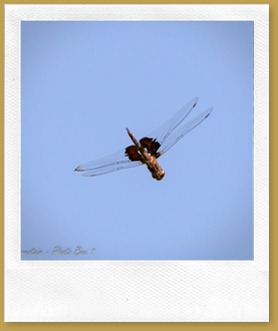
Today I even tried to photograph one of the larger species of dragonflies flying over Rico Lake. In order to accomplish this I utilized my 70-200 mm lens and my bird in flight technique. I watched how the dragonflies were flying and noticed that they were following closely to a similar path most of the time. So I pre-focused and then would panning followed and took the pictures. As you can see from the picture I did capture the dragonfly in flight however, it is not the best or sharpest picture. Oh well it'll take more work to try to accomplish this task.

For those  of you who are interested in dragonfly photography I recommend a free e-book from photo naturalist which was written by Vic Beraedi. In the book he gives good references to the literature that help you identify which species that the damselflies or dragonfly belong to. For those of you who live in Massachusetts, the state fishing game service has a publication A Field Guide to the Dragonflies and Damselflies of Massachusetts 2nd Edition (2007) by Blair Nikula, Jennifer Loose, and Matthew Burne available-for-sale. If you go to <http://www.mass.gov/dfwele/dfw/nhesp/publications/nhesp_pubs.htm> you can download an order sheet to mail away for this publication.
Here are some of my photographs from the last few days.Autumn Meadowhak D7K_0483 NIKON D7000 July 21, 2011Autumn MeadowhawkBlue Dasher D7K_0356 NIKON D7000 July 20, 2011Blue DasherBlue Dasher D7K_0359 NIKON D7000 July 20, 2011Blue dasher
Female Blue DasherBlue Dasher femaleD7K_0352 NIKON D7000 July 20, 2011Bluet Mating _DSC6071Macro-Damsel-Dragon-Flowers-Butterfly-scenic-Edit NIKON D300 June 16, 2010Bluet Matingbo Violet Dancer female sumac D7K_0244 NIKON D7000 July 19, 2011Violet Bluet _DSC6097Macro-Damsel-Dragon-Flowers-Butterfly-scenic NIKON D300 June 16, 2010Dancerbo Violet Dancer male D7K_0251 NIKON D7000 July 19, 2011bo Violet Dancer male D7K_0257 NIKON D7000 July 19, 2011Common or Eastern Pond Hawk D7K_0128 NIKON D7000 July 18, 2011Common or Eastern PondhawkCommon or Eastern Pond Hawk D7K_0134 NIKON D7000 July 18, 2011Common Pondhawk D7K_0119 NIKON D7000 July 18, 2011Dragonfly flight D7K_0305 NIKON D7000 July 20, 2011Dragonfly flightFragile Forktail D7K_0078 NIKON D7000 July 18, 2011


Fragile Forktail
Stream Bkuet D7K_0396 NIKON D7000 July 21, 2011Stream Bluetta Violet Dancer female on Sumac D7K_0244 NIKON D7000 July 19, 2011Violet Dance femaleViolet Dancer female _DSC6032Macro-Damsel-Dragon-Flowers-Butterfly-scenic NIKON D300 June 16, 2010Violet Dancer female D7K_0144-Edit NIKON D7000 July 18, 2011Violet Dancer female sumac D7K_0244 NIKON D7000 July 19, 2011on SumacWandering Glider _D3S1298-Edit NIKON D3S October 02, 2010Wandering Gliderwidow skimmer female D7K_0332 NIKON D7000 July 20, 2011Female widow Skimmer
Here is a slide video of a Bluet laying an egg