Showing posts with label Mute Swan. Show all posts

Thursday, May 5, 2016

New Life

Cygnet
The kids and I went out photographing yesterday and the fun part was photographing a family of goslings and a family of cygnets.  The interactions between the adults in the youngsters was interesting.  The Canada geese, adults, both monitored their goslings while the mute swan female was in charge of the cygnets.  The cob mute swan job was to protect them and he spent his time chasing Canada geese.  Nobody got hurt in the interactions.  The one thing we can hope for is that the little ones have a chance to grow up.  The biggest problem is in Jenney pond, there is a large snapping turtle that lives there and in previous years decimated the population of cygnets.
Goslings
Cygnet
Mute Swan With Her Cygnets
Mute Swan Cob Chasing a Canada Goose Who Is Trying to Protect Its Goslings

Do not forget the Topaz special sale that is offering $200 discount on the full Topaz photography collection.  You must use the coupon code SPRINGSUMMER2016  http://www.topazlabs.com/aff/idevaffiliate.php?id=850&url=http://www.topazlabs.com/store

Sunday, March 13, 2016

Aggressive Behavior

American Black duck and if you look closely at its speculum the border is black
Yesterday, I showed you how to remove and replace backgrounds.  Today's blog is just discussing the shoot at Jenney's Pond on Friday.

The swan gander and one of the Canada geese ganders were aggressive.  The mute swan would chase Canada geese.
 Mute swan with its wings half raised, known as busking, is a threat display
As other Canada geese started to come in where the Canada goose gander was it became very aggressive and chased them away.  It even chases them into flight.
Canada geese threatening each other
Canada goose, chasing another Canada goose into flight
Of all my pictures that I took on Friday, only 6% made it into keepers. I deleted all the pictures that were out of focus and tagged the 6% by color and star.  I am becoming more critical of what I keep.  Of the remaining pictures which are not tagged and at this point, not worthy, but I keep them.  Because postprocessing keeps improving.  I am still reviewing old the pictures and reprocessing a number of them, and then tossing the older processed pictures away.

Friday, July 10, 2015

First Visit to Broadmoor

Mute Swan Family 
Last evening, I met my friend and colleague John Slonina, at Broadmoor Massachusetts Audubon Sanctuary with his meet up group.  My plan was to help him if needed and also to photograph the sanctuary since it was my first visit.  I was lucky driving up to the sanctuary not to have very much traffic and arrived early.  So while I was waiting I searched along the vegetation by the fence and photograph some interesting creatures.  The most interesting was a leaf-footed bug (Acanthocephala terminalis).  What makes it distinctive is that the terminal segment of its antenna is orange compared to the rest of the body, which is a dark color.

Leaf-footed Bug (Acanthocephala terminalis)

After the group arrived, and we did introductions, John let us down to the marsh and pond area where we photographed vegetation, swans, landscapes and finally when we were leaving a bull frog croaking around the lily pads.  John gave suggestions on how to improve people's photography and was hopeful in teaching how to think out-of-the-box.  His motto is to work on a subject, photograph the subject horizontally, vertically, high up, low down, change your angle of view, worked the exposure triangle.  These are all useful hints.

John talking to the group
The group photographing a subject
Today, I downloaded and processed my pictures and added interpretations of how I saw the landscape.  Some of the photos I processed so they were natural and others I processed in the impressionistic mode.
Feather Floating on Duck-Weed Post Process Topaz Glow
Feather Floating on Duckweed
Black and White Reflections
Reflections Processed As a Sunset Shot
Water Flowing over a Rock Dam
Reflections in the Water Impressionistic Style
Black Duck Swimming
Common Bullfrog Croaking
For more information about John, please visit his website http://www.sphotography.com/.  John runs excellent workshops throughout the Northeast and through the United States.

Using the coupon code mborn you will receive a 15% discount on any or all of the Topaz plug-ins.


Help Support my blog by purchasing from Amazon. Clicking on this link and utilizing the link does not cost you anything.
BUY FROM AMAZON

Sunday, May 24, 2015

A Long Morning at Gooseberry

Milky Way panorama at Gooseberry
Saturday, we spent a long morning at Gooseberry, from 3:15 AM until 7:30 AM.  It was a very clear night, with a brisk wind blowing in the Milky Way rising out of the Southwest and continuing overhead toward the Northeast.  The Milky Way presented different opportunities to photograph from various positions.  In fact, in some of the photographs, we even captured meteors and satellites.
Milky Way at Gooseberry

Milky Way at Gooseberry

Milky Way at Gooseberry

A few clouds started drifting in and as we waited for dawn to break, I took pictures of astronomical, nautical and civil dawn and then finally the sunrise.  We had some good color, but, if there were more clouds.  I think we would had had better color.  At the time of astronomical dawn, I was able to photograph the Big Dipper, Cassiopeia and Polaris.
Astronomical Dawn with the Big Dipper, Cassiopeia and Polaris

Nautical Dawn

Civil Dawn

sunrise

After sunrise, I utilize the golden light to take some landscapes along with different birds in flight.  What really made it interesting was the number of common loons flying overhead, which present the great subjects to photograph.
Landscape In the Golden Light

Common Loon in the Golden Light

Common Grackle's in the Golden Light

A wedge of swans flew from West to East and I was able to get one picture with the wings of the swans almost up and down.
Wedge of Mute Swans

Yellow warblers were flitting around and presented great subjects to photograph in a flowering tree.
Yellow Warbler in a Flowering Tree
Common Yellowthroat

To process the Milky Way photographs.  I utilized Collier's suggestion in his new book that I recently reviewed. http://photobee1.blogspot.com/2015/05/colliers-guide-to-night-photography-in.html


Using the coupon code mborn you will receive a 15% discount on any or all of the Topaz plug-ins.


Help Support my blog by purchasing from Amazon. Clicking on this link and utilizing the link does not cost you anything.
BUY FROM AMAZON

Monday, April 21, 2014

Meetup Morning at Great Meadows National Wildlife Refuge

Red-winged Blackbird Singing and Displaying
This morning I joined a Meetup group organized by Mike Milica at Great Meadows National Wildlife Refuge - Concord Unit. We met at 5:45 AM in the parking lot where Mike explained that the main object was trying to get male Red-winged Blackbirds displaying on the reeds or on the cattails, plus whatever else we could find to photograph. The plan was that we would all spread out since the dike trail is long enough to support us without being in each other's way.

As we started walking down the trail, the first bird that I observed was a female red-winged blackbird, which I photographed high-key so that I could completely blow out the background.

Female Red-winged Blackbird
Then I joined the group photographing a very cooperative Great Blue Heron who was standing in the water which was flowing in between the two impoundments. Everyone had a chance to obtain photographs of this bird.
Great Blue Heron
The rest of the morning was taken up trying to get the red-winged blackbirds singing and displaying what out being obstructed by objects in front of them by having sticks coming out of their head. It required a lot of patience and moving around to get the best angle.
Red-winged Blackbird In-Flight

Some of the other species that I photographed included a singing Common Grackle in great light showing off its beautiful iridescence. A pair of mute swans went through different display modes, then they mated and displayed again afterwards. Most of the ducks and geese were far away, however, a male Wood Duck swam close to the shore line and required careful placement of the camera and lens in order to get a clean photograph of this beautiful duck.

Common Grackle Show in Its Beautiful Iridescence As It Was Singing
Mute Swans Mating

Mute Swans Displaying after Mating
Wood Duck
Near the end of the meetup, Mike went over manual exposure and how to set exposure utilizing a grey card or an incident exposure meter. Interesting my Nikon D3s was two thirds of a stop on the the recommended reading while my Nikon D7100 was right on. When I am shooting this is something that I have to keep in mind. It was a great day and I met some new friends at hopefully we will get together shooting again in the near future.

Thursday, November 7, 2013

My Thoughts and How and Why I Did It

In a previous blog, I shared How I Did It.  Because of some of the replies that I received, I am going to continue with more of my thought processes and how I did it, utilizing Lightroom, Photoshop, and plug-ins.

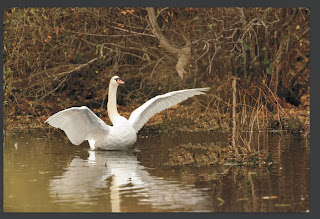
In my last blog, I had the picture of the mute Swan with its wings spread and the other Swan with its head out of the water.  I had a different picture of the mute Swan with its wings spread, but the other Swan had its head under the water.  My thought was that I would like to post process this picture and only keep the Swan with its wings spread in it.
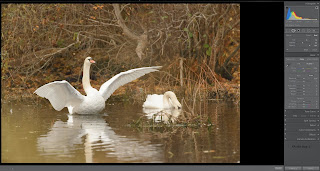


Here is the original picture, I first try to remove the second Swan using the spot removal tool in Lightroom, but it would not work.  So I did my initial processing of the picture in Lightroom.
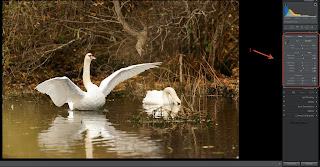


Exporting the picture, utilizing control-E, into Photoshop, I added a new layer, utilizing the layer button at the bottom of the layers panel.  I then utilize the clone stamp, taking pieces from different parts of the picture and then help blend it utilizing the lasso tool and contents aware.


Once I had it to my liking, I did my first crop.


 I have been utilizing Topaz clarity plug-in for many of my pictures.  I like it because it doesn't give halos and that the presets are easily customized utilizing the sliders and/or the mask.  I duplicated the layer and then opened Topaz clarity.  In Clarity: 1 - Picked the Collection to use; 2 - Picked the Pre-set to use;  3 - Adjusted the preset to my taste.


After I was finished, I flatten the picture in Photoshop and then exported the picture as a PSD back into Lightroom, where I've made a few more adjustments and fixed the crop.

Final Result
I hope this has been useful and if you have any questions please email me.